Who Pays for NATO? • Part II of The Price of Power
America does spend more on defence than its NATO allies, but that does not mean Washington pays for NATO. The alliance also delivers strategic access, influence and a vast market for U.S. weapons. The real question is not what NATO costs America, but what American leadership buys in return.
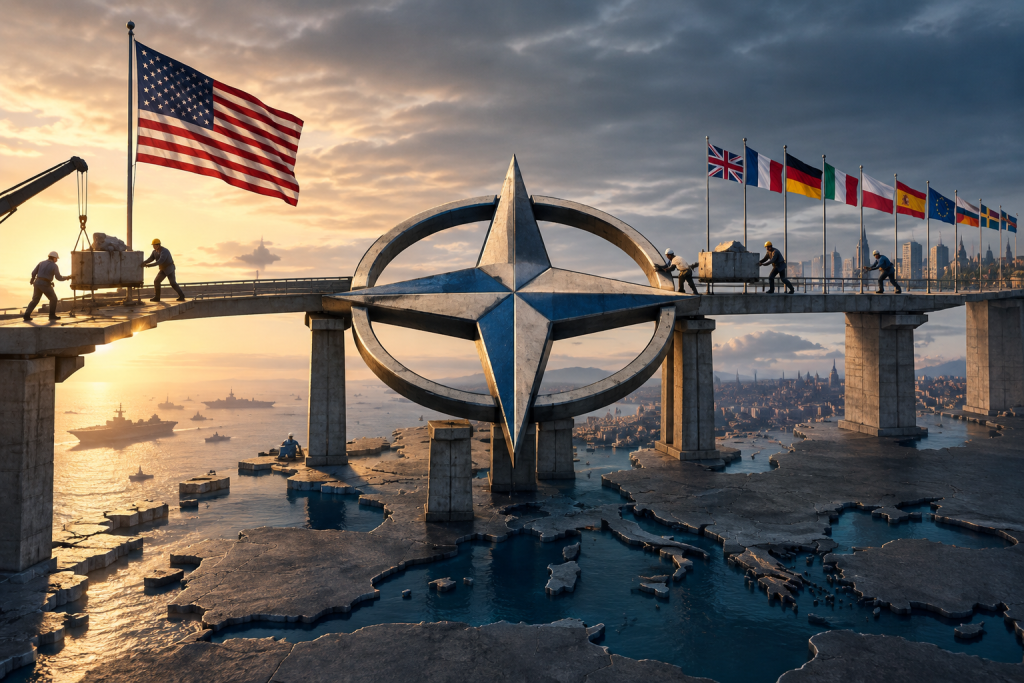
One of the most persistent claims in American politics is that the United States “pays for NATO.” It has become shorthand for a much broader argument: Europeans have supposedly spent decades enjoying American protection while Washington picked up the bill. There is a legitimate debate buried inside that claim. The United States has maintained military capabilities that many European allies allowed to weaken after the Cold War, and American governments of both parties have complained for years that Europe needed to spend more on its own defence. But the familiar political version of the argument confuses three very different things: NATO’s actual budget, the national military budgets of its members, and the economic and strategic benefits the United States receives from leading the alliance.
The distinction matters because the United States does not fund NATO in anything resembling the way the rhetoric suggests. NATO’s common budgets are comparatively small and shared among all 32 members. The enormous American defence budget, by contrast, finances a global military whose responsibilities stretch from Europe through the Middle East to the Indo-Pacific. Treating the entire Pentagon budget as the cost of defending Europe is no more accurate than treating Britain’s entire defence budget as a contribution to NATO headquarters in Brussels.
Once those accounts are separated, NATO begins to look less like a protection scheme financed by one country and more like what it has always been: a military alliance in which the United States bears substantial costs but also receives substantial strategic, political and commercial advantages.
NATO’s Budget Is Not America’s Defence Budget
In 2025, NATO estimated that the United States accounted for about 60 per cent of the alliance’s combined nominal defence expenditure. European allies and Canada spent roughly US$574 billion in constant 2021 dollars, while American military expenditure remained substantially larger. Those figures are real, and they help explain why the United States supplies capabilities that Europe still struggles to reproduce on its own. They do not, however, mean that Washington paid 60 per cent of NATO’s bills. NATO itself distinguishes national defence expenditure from the money required to operate the alliance as an institution.
The actual common funding of NATO is measured in billions of euros rather than hundreds of billions of dollars. For 2026, the alliance approved up to €5.3 billion in common funding across its civil budget, military budget and Security Investment Programme. The civil budget finances NATO headquarters and its international staff. The military budget supports the integrated command structure, exercises, operations and other collective functions. The infrastructure programme pays for shared facilities and capabilities that individual countries would not sensibly finance alone.
The United States does not dominate those budgets. Under the cost-sharing formula in force for 2026 and 2027, the American contribution is 14.9039 per cent. Germany pays exactly the same percentage. France contributes just over 10 per cent, Britain slightly more than 10 per cent, Italy about 8 per cent and Canada about 6.6 per cent. The formula reflects the relative economic weight of the members rather than an assumption that Washington should underwrite the organization.
This makes the popular phrase “America pays for NATO” misleading before the argument has even reached military capability. The United States spends more on defence than its allies because it maintains by far the largest military in the alliance, but most of that money pays for American forces under American command serving American strategic objectives around the world. The cost of a carrier strike group operating in the Pacific, American nuclear forces, troops stationed in South Korea or military infrastructure supporting operations in the Middle East does not become a NATO expense simply because the United States is a member of NATO.
Europe Did Underinvest
Correcting that misunderstanding does not erase Europe’s own failures. For years after the Cold War, many European governments reduced defence spending on the assumption that the continent faced no immediate conventional military threat. Armed forces became smaller, ammunition stocks declined and expensive capabilities were postponed. The United States retained intelligence, surveillance, refuelling, missile-defence and logistical capacity on a scale that most European countries could not match individually.
Washington had good reason to complain. NATO figures show that European allies and Canada were spending only around 1.4 per cent of their combined GDP on defence in 2014. Russia’s seizure of Crimea that year began reversing the decline, while the full-scale invasion of Ukraine in 2022 made the inadequacy of European military capacity impossible to ignore. By 2025, every NATO member had met the former benchmark of spending at least 2 per cent of GDP on defence, and European allies and Canada had raised their combined expenditure to about 2.33 per cent of GDP.
The burden-sharing problem was therefore real, but it was a problem of military capability rather than unpaid membership dues. European states depended too heavily on American assets in several important areas, and rebuilding those capabilities will take years even with much higher budgets. The newer NATO target agreed at The Hague pushes members toward 3.5 per cent of GDP for core military requirements, with another 1.5 per cent potentially devoted to resilience, infrastructure and related security spending. That money will remain overwhelmingly national expenditure rather than a transfer to NATO.
This distinction is important because the language of “paying for NATO” turns an argument about how much military capability each ally should provide into the false impression that Europe owes Washington a bill. NATO was never structured that way. Each member finances its own armed forces while contributing a much smaller amount toward the institutions and infrastructure they use collectively.
American Forces in Europe Serve American Interests Too
The United States has unquestionably spent heavily to maintain forces in Europe, but those deployments have never served European security alone. Geography gives the United States military access that cannot be replicated from North America. Bases and headquarters in Germany, Italy, Britain, Spain and elsewhere provide airfields, ports, logistics, communications and command facilities close to the Mediterranean, the Middle East, North Africa and western Eurasia.
This is why the American military presence in Europe has repeatedly supported operations far beyond NATO’s traditional territorial defence. U.S. Africa Command is headquartered in Stuttgart. The U.S. Sixth Fleet operates from Naples. Ramstein Air Base in Germany has been one of the most important logistical and command hubs available to the United States for operations extending well beyond Germany itself. These facilities help protect European allies, but they also allow Washington to position forces thousands of kilometres closer to regions in which successive American administrations have chosen to intervene or maintain a military presence.
The alliance has also operated in America’s defence when required. After the terrorist attacks of September 11, 2001, NATO invoked Article 5 for the first and only time in its history. Allied airborne warning aircraft helped patrol American skies, while member states provided overflight rights, intelligence, facilities and forces for the campaign in Afghanistan. NATO records that aircraft from allied countries flew hundreds of sorties over the United States after the attacks.
None of this eliminates the cost to Washington of maintaining the largest military force in NATO. It does, however, make clear that American forces in Europe are not analogous to a private security company guarding someone else’s property. They are part of a global American military posture that gives Washington access and reach it considers important to its own security and foreign policy.
Europe Is Also a Market
The commercial side of the relationship receives much less attention than the spending debate, although it is becoming increasingly important as Europe rearms.
European demand for American weapons has risen dramatically since Russia’s invasion of Ukraine. The Stockholm International Peace Research Institute found that the volume of U.S. major-arms exports to Europe increased by 217 per cent between 2016–20 and 2021–25. Europe accounted for 38 per cent of all American major-arms exports during the latter period, making it the largest regional destination for U.S. weapons for the first time in two decades. Among European NATO members, the United States supplied 58 per cent of major arms imported during 2021–25.
Those figures should be handled carefully. SIPRI measures the volume of major weapons transfers rather than commercial revenue, and the totals include military assistance as well as purchases. They therefore cannot be converted directly into a dollar figure for American industry. What they do show is the scale of European reliance on American weapons and the exceptional position that U.S. manufacturers occupy inside the European defence market.
That relationship extends well beyond the original purchase. A combat aircraft, missile-defence system or advanced sensor typically remains in service for decades. Operators require training, spare parts, weapons, maintenance, software updates and modernization. Once a military has built doctrine, infrastructure and supply chains around a particular system, changing suppliers becomes expensive and complicated.
NATO interoperability reinforces that effect. Allied forces need to communicate, exchange information, use compatible ammunition and operate together during deployments. Common standards are militarily necessary, but they also favour suppliers already deeply integrated into the alliance. The United States entered that market with the world’s largest defence industry and the alliance’s most powerful armed forces, creating commercial advantages that have accumulated over decades.
SIPRI notes that American arms exports serve political purposes as well as military ones. Buyers gain advanced equipment and closer security relations with Washington, while the United States uses weapons transfers to strengthen its defence industry and reinforce foreign-policy relationships. The Trump administration’s own America First Arms Transfer Strategy explicitly treats exports as an instrument of U.S. power.
Calling NATO itself a “cash cow” would therefore oversimplify the accounting, because the United States bears genuine military costs that cannot be subtracted neatly from defence sales. What can be demonstrated is more significant than the slogan: the American-led alliance has helped create an exceptionally valuable and durable market for American weapons, while simultaneously tying allied military planning to American technology and supply chains.
Defence Spending Can Return to the United States
This becomes particularly important when American politicians demand that Europe spend more.
If a European NATO member increases its defence budget to buy American aircraft, American missiles, American air-defence systems or American sensors, part of the new European defence spending becomes demand for U.S. industry. European rearmament therefore does not automatically represent an additional economic burden on the United States. Depending on how procurement decisions are made, it can create more business for American manufacturers.
The recent numbers demonstrate how strongly that process has already operated. European arms imports more than tripled between 2016–20 and 2021–25, and nearly half of all major arms transferred to European states during the latter period came from the United States. American exports to Europe rose far faster than U.S. exports overall.
This does not mean European governments buy American weapons as a favour to Washington. They often select them because the systems are proven, available, compatible with allied forces or difficult to match quickly from domestic production. Nor does it mean European industry is insignificant. EU members collectively remain major arms exporters, with France, Germany, Italy and Spain among the world’s important suppliers.
What matters is that NATO has historically placed U.S. industry in an unusually favourable position when European countries increase military spending. That makes the current European drive to expand domestic arms production strategically important not only for Europe but for the United States. If European governments continue raising their defence budgets while shifting a larger share of procurement toward European companies, Washington may obtain the stronger allies it has demanded while American manufacturers lose some of the commercial advantage that accompanied European dependence.
The Alliance Multiplies American Power
The larger benefit of NATO is more difficult to enter into a budget spreadsheet because it is political rather than purely financial. The United States sits at the centre of a military alliance containing most of the world’s advanced Western economies. Its forces have access to allied territory. Its military planners work continually with allied officers. Intelligence is shared across networks that took decades to build. American equipment is used by numerous allied armed forces, and strategic decisions affecting an enormous portion of Europe are made within an institution in which American military capabilities remain central.
This is what American primacy has looked like in practice. It has not required Washington to control its allies or extract direct tribute from them. The greater advantage has been creating an international structure in which other powerful countries frequently choose to organize their defence around American leadership.
That structure has costs. It obliges the United States to maintain forces and capabilities that are expensive to operate, and it creates expectations that Washington will act when its allies are threatened. Europe’s post-Cold War underinvestment shifted too much of several critical military functions onto the United States, and European governments are now spending heavily to correct that imbalance.
Yet judging NATO only by comparing national defence budgets misses much of what Washington receives. America gains strategically useful geography, military partners, intelligence networks, standard-setting influence and one of the world’s most lucrative markets for advanced weapons. It also gains allies whose own forces increase the total military capacity available to a coalition the United States leads.
The relevant question is therefore not whether NATO has cost the United States money. Of course it has. The relevant question is whether those costs purchased something valuable.
For more than seven decades, American governments from both parties repeatedly answered yes.
A Different Balance Is Emerging
This matters to The Price of Power because NATO now sits at the centre of a transition. The United States has spent years urging Europe to take greater responsibility for its defence, and Europe is finally doing so on a scale not seen since the Cold War. Russia provided the overriding security reason, while American pressure reinforced the political demand.
A stronger Europe should reduce some of the military burden carried by the United States. It could provide more ammunition, more deployable forces, more air defence and greater capacity to deter Russia without requiring American forces to supply every high-end capability. From the narrow perspective of burden-sharing, that is exactly what Washington has requested.
The unanswered question is whether Europe will simply become a better-funded version of the defence system that existed before, or whether it will use the spending surge to reduce its dependence on the United States itself.
That difference has enormous consequences.
For decades, European military weakness reinforced American leadership. European governments relied heavily on U.S. capabilities and purchased large quantities of American equipment, while Washington gained both strategic influence and commercial advantage. If Europe now builds more of its own weapons, develops more of its own high-end capabilities and keeps more of its defence spending inside Europe, the balance begins to change.
The United States may ultimately discover that making Europe pay more was never the difficult part. The more consequential question is what happens when Europe becomes capable of deciding for itself where that money goes.
That is the next stage in the price of power.
Sources
NATO — Funding NATO — NATO’s explanation of common funding, national defence expenditure and the 2026–27 cost-sharing formula.
NATO — Secretary General Annual Report 2025 — current allied defence expenditure and the respective shares of the United States and European allies.
SIPRI — Global Arms Flows Jump as European Demand Soars — 2021–25 arms-transfer data, including the growth of U.S. exports to Europe and American market share among European NATO members.
SIPRI — Trends in International Arms Transfers, 2025 — broader data on U.S., European and global weapons transfers.
NATO — Countering and Preventing Terrorism — NATO’s invocation of Article 5 after September 11 and allied operations in support of the United States.