Release Your Reserves or Lose Our Diesel: Trump Turns Energy Supply Against Europe
Washington is reportedly pressing France and Germany to release emergency diesel reserves while dangling the threat of a U.S. export ban. The dispute exposes a harsher reality: under Trump, economic dependence is becoming political leverage, and allies are learning to plan around it for themselves.
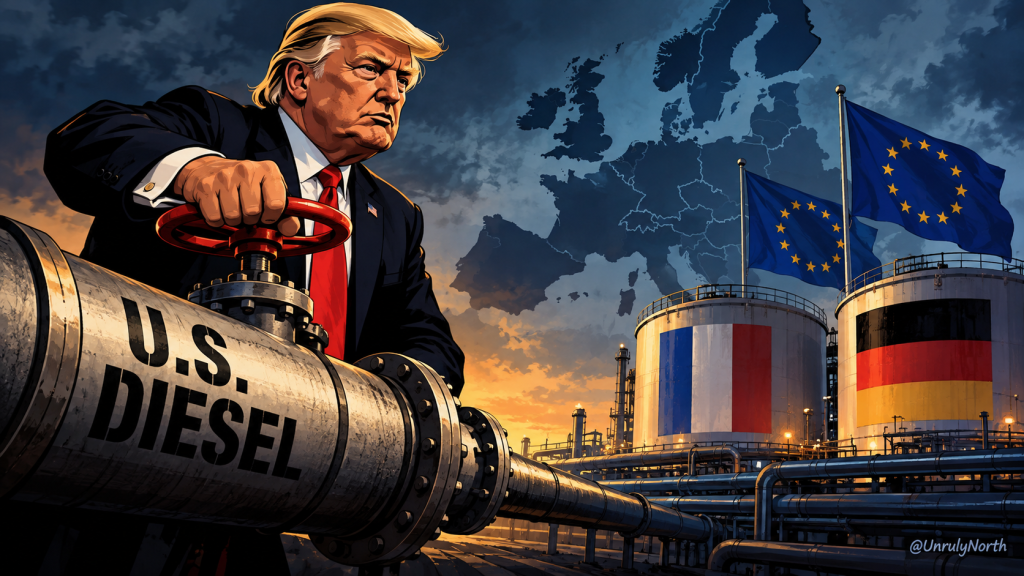
The Trump administration has reportedly presented two of America’s closest European allies with a remarkable choice: release more of the emergency diesel reserves they maintain for their own security, or risk having the United States restrict the diesel exports on which Europe increasingly depends.
According to Reuters, three people close to the discussions say Washington has told Germany and France to draw down emergency diesel inventories as global fuel prices soar. Another source said the United States wants the European Union to release 120 million barrels of diesel over the next six months. The alternative hanging over those discussions is a potential American diesel export ban. President Donald Trump has already publicly backed the idea of restricting exports as his administration searches for ways to lower record domestic fuel prices before November’s midterm elections.
There is an important qualification. No export ban has been implemented, and the administration has explored other options. The White House previously denied reports that a 90-day ban was being prepared. France has not publicly confirmed the reported ultimatum, and Germany’s economy ministry says the International Energy Agency has not asked it to undertake another emergency release.
But the threat itself matters.
This is no longer simply a disagreement among allies over how quickly emergency stocks should enter the market. If the Reuters account is accurate, Washington is linking continued access to American fuel to European governments making a policy decision Washington wants them to make.
That is economic coercion in its most straightforward form: exploiting a trading partner’s dependence on something you control to increase the cost of saying no.
And it illustrates precisely why countries around the world are becoming increasingly uncomfortable with dependence on the United States, even when they continue to regard America as an ally.
This Is Not How Emergency Reserves Were Supposed to Work
There is a legitimate argument for releasing strategic oil stocks.
Emergency reserves exist to be used.
International Energy Agency members are required to maintain oil stocks equivalent to at least 90 days of net imports and to participate in coordinated responses to severe disruptions in global supply. Europe has similar rules requiring EU members to maintain reserves corresponding to at least 90 days of average daily net imports or 61 days of average daily domestic consumption, whichever is greater.
The world is also facing a genuine emergency.
The Middle East conflict has severely disrupted petroleum flows through the Strait of Hormuz. Russian diesel supplies have been constrained further by export restrictions and damage to Russian refineries. Chinese refiners suspended fuel exports for October to protect domestic inventories. Diesel prices have consequently risen sharply across both Europe and the United States.
Nobody needs to invent a crisis to justify discussing another coordinated release.
In March, IEA countries unanimously agreed to undertake the largest emergency oil release in the organisation’s history in response to the Middle East disruption. The final allocation amounted to roughly 426 million barrels. The United States accounted for 172.2 million barrels. France was allocated 14.6 million and Germany 19.5 million. European contributions were expected to consist heavily of refined petroleum products rather than crude oil.
Washington says some European countries have not fully delivered what they committed to release. Energy Secretary Chris Wright has publicly complained that several European IEA members released only a fraction of their pledged volumes, while Treasury Secretary Scott Bessent has argued that the United States fulfilled its own commitment and expects allies to do the same. The EU has not published a complete accounting that would independently settle the dispute.
That is a serious issue and deserves an answer.
But there is an established mechanism for answering it.
The IEA exists precisely so governments can assess supply conditions, determine whether emergency releases are necessary and coordinate contributions among members. France is now proposing a G7 discussion on fuel prices and reserve releases in coordination with the IEA. Germany has pointed out that the IEA itself has not yet requested another German release.
There is a considerable difference between telling an ally, “You have not fulfilled the emergency commitment we made together,” and telling it, “Release additional reserves or we may restrict the fuel we sell you.”
One is an argument over burden-sharing.
The other introduces dependency as leverage.
Europe Has Given Washington Plenty of Leverage
That leverage exists because Europe is vulnerable.
France and Germany together hold more than one-third of the European Union’s strategic diesel reserves. Reuters reports Germany holds roughly 5.6 million tonnes and France about 8.2 million tonnes. The proposed American request for 120 million barrels over six months would amount to more than 40 per cent of the EU’s current emergency diesel and gasoil stocks.
Those are not decorative barrels sitting around waiting for somebody to think of a use for them.
Europe is heading toward winter amid an unusually fragile fuel market. The Middle East remains unstable. Russian supply is constrained. China is prioritising its own domestic stocks. Europe has also lost substantial refining capacity over the past decade and a half, increasing its need to import finished petroleum products.
The United States has become increasingly important in filling that gap.
U.S. Energy Information Administration data show that American diesel exports to Europe more than doubled between January 2025 and January 2026, rising from roughly 167,000 barrels per day to 396,000 barrels per day. The shift followed tighter availability from other suppliers and the restructuring of European petroleum trade after Russian energy imports were restricted.
That increased trade made economic sense.
It also created leverage.
Europe spent years learning, painfully, that cheap and reliable supply is not the same thing as secure supply. Dependence looks efficient until political circumstances change. At that point the spreadsheet gives way to strategy.
The mistake would be to conclude that replacing Russian dependency with American dependency automatically solved the problem.
Russia and the United States are not equivalent political systems, economic partners or security relationships. Europe is allied with the United States. It fought an undeclared economic and strategic confrontation with Moscow after Russia invaded Ukraine.
But energy security does not require pretending different countries are identical. It requires understanding that dependency itself carries risk whenever the supplier can use access to influence political decisions.
The reported diesel ultimatum demonstrates that risk with unusual clarity.
America’s Domestic Political Problem Is Becoming Europe’s Strategic Problem
The immediate political pressure is not difficult to identify.
American diesel prices have reached record levels. Reuters reported prices above US$6.50 per gallon in late September. Diesel is fundamental to trucking, farming, construction and industrial transport, which means increases propagate through the price of almost everything moved by road or produced with diesel-powered equipment.
That would be politically painful at any time.
It is especially painful weeks before congressional elections.
Trump publicly endorsed keeping American diesel at home on September 22, telling reporters he had already raised the proposal inside his administration. Republican candidates in several contested races have also demanded restrictions on exports as voters confront elevated fuel and living costs.
There is therefore nothing mysterious about Washington’s objective. Increasing the amount of diesel available globally could reduce prices. Keeping more American diesel inside the United States could, at least temporarily and in some regions, increase domestic supply.
The American government has every right to pursue policies intended to protect American consumers.
European governments possess exactly the same right.
France and Germany must decide how much emergency fuel they are prepared to release while assessing their own winter demand, European industrial requirements, the continued Middle East conflict and the possibility that the global supply situation becomes worse rather than better.
That is why linking European reserve policy to continued American exports changes the character of the discussion.
The United States is no longer merely arguing that another coordinated release would be mutually beneficial. Under the scenario reported by Reuters, it is warning European governments that refusing could result in Washington making their supply situation more difficult.
For an alliance supposedly based upon consultation and mutual security, that is a dangerous precedent.
The Threat Is Even Stranger Because Washington Knows It Could Backfire
The proposed export restriction has another problem: senior members of Trump’s own administration have warned that it may be economically self-defeating.
Energy Secretary Chris Wright has argued that blocking exports could leave excess diesel stranded around the U.S. Gulf Coast. Refineries cannot simply keep producing indefinitely while storage tanks fill. Eventually they would have to reduce the amount of crude they process.
And refineries do not manufacture diesel in isolation.
Reducing refinery runs also reduces the production of gasoline, jet fuel and other petroleum products. Wright’s warning was straightforward: barriers to fuel flows can eventually mean less overall supply rather than more. Interior Secretary Doug Burgum has separately warned that export restrictions could invite retaliation from other energy-exporting countries.
Market analysts have reached similar conclusions.
Wood Mackenzie estimated that an export ban could create roughly 700,000 barrels per day of surplus diesel and gasoil on the Gulf Coast, filling available storage in little more than a month. Preventing inventories from overflowing could then require American refiners to cut crude processing by more than two million barrels per day, approximately 12 per cent of U.S. refinery runs at current levels.
The United States is the world’s largest net exporter of diesel, at roughly 1.2 million barrels per day. Those exports are not an act of charity. They exist because America has enormous refining capacity and produces more diesel than its domestic market absorbs.
An export ban could therefore produce the peculiar spectacle of Washington restricting a commercially valuable industry, damaging allied energy security and potentially forcing its own refiners to reduce production in order to address a supply problem.
That does not mean a limited restriction could have no short-term effect on American prices. It means the policy involves serious trade-offs that even Trump’s own energy officials have acknowledged.
Using such a policy as leverage against allies does not make those trade-offs disappear.
The Real Cost Is Trust
The most consequential part of this dispute may ultimately have little to do with the 120 million barrels themselves.
Europe may release more reserves.
There are perfectly rational reasons for doing so. Putting additional diesel into a severely constrained market could reduce prices for European consumers as well as Americans. The IEA may ultimately support another coordinated release. France’s proposal for a G7 discussion suggests European governments themselves recognise the seriousness of the shortage.
But governments remember how suppliers behave when circumstances become difficult.
That calculation affects decisions years later about refineries, pipelines, strategic stockpiles, electricity generation, defence procurement, shipping routes and trade agreements.
For decades, one of America’s greatest economic advantages was not simply that it could supply allies. It was that allies could often build long-term systems around American access with confidence that commercial relationships would remain embedded within a relatively predictable political order.
Every threat to interrupt those relationships for political leverage changes the equation.
A European government considering future energy infrastructure does not need to decide that America is an enemy. It only needs to conclude that American supply can no longer be treated as politically risk-free.
That is enough to justify redundancy.
More domestic refining becomes easier to defend. Alternative suppliers become worth cultivating even if they cost slightly more. Strategic reserves become more valuable, not less. Governments become more reluctant to allow one country to dominate critical supply chains.
The irony is difficult to miss: threatening allies because they are dependent on the United States gives those same allies another reason to become less dependent on the United States.
Dependence Is Not Partnership
There is a broader lesson here for Europe, Canada, Japan, Australia and every other country attempting to navigate a world of increasingly transactional great-power politics.
Diversification is not anti-American.
It is not anti-Chinese, anti-European or anti-anything else.
It is insurance against the political consequences of excessive dependence.
A country that obtains a critical resource from five reliable sources has choices. A country that obtains most of it from one source has a relationship that can be exploited regardless of how friendly that relationship appeared when the contracts were signed.
That principle applies to diesel. It applies to critical minerals, semiconductors, defence equipment, financial infrastructure, cloud computing, food, pharmaceuticals and telecommunications.
Globalisation rewarded efficiency. The emerging international order is placing a premium on resilience.
Those objectives are not always compatible.
Maintaining excess capacity costs money. Buying from several suppliers can be less efficient than concentrating purchases with the cheapest producer. Domestic production can cost more. Strategic reserves require capital to maintain.
But the alternative has a price as well, and that price becomes visible when a supplier says access depends upon political compliance.
The Trump administration’s reported pressure on France and Germany is therefore larger than an argument about fuel inventories.
It is a demonstration of what economic dependence can become when political relationships deteriorate.
Europe does not need to sever its enormous energy relationship with the United States. Doing so would be economically irrational, particularly in the middle of a global fuel shortage.
It does need to ensure that losing American supply would be painful rather than catastrophic.
That distinction is the foundation of genuine strategic autonomy.
An Ultimatum Can Work and Still Be a Mistake
Washington may get what it wants.
France, Germany and other European governments may conclude that another substantial release is justified. Global diesel prices could ease. American consumers could benefit. European consumers could benefit as well.
Success, however, would not erase the method.
If European governments release strategic reserves because their own assessment concludes that market conditions warrant it, that is emergency energy policy.
If they release them because Washington has made clear that refusing could result in American supplies being restricted, the decision takes place under economic pressure.
The distinction matters because alliances are not sustained by pretending that powerful countries never possess leverage over weaker ones. They are sustained by restraint in how that leverage is used.
America’s enormous market, military power, financial system, technology industry and energy sector give Washington extraordinary influence. Those advantages become more durable when other countries regard American power as something around which they can safely build.
They become less durable when governments begin designing systems specifically to protect themselves from Washington.
A diesel export threat will not dismantle the transatlantic alliance. France and Germany will not suddenly turn away from the United States. American and European interests remain far too intertwined for such melodrama.
Something quieter is happening.
Governments are learning to calculate American political risk.
They are learning that economic integration can produce vulnerabilities as well as prosperity. They are learning that strategic autonomy requires alternatives before they are needed. And they are learning that the ability to say no to a powerful partner depends heavily on whether that partner controls something you cannot afford to lose.
That lesson will outlast the current diesel shortage.
The most important consequence of Washington’s reported ultimatum may therefore have nothing to do with how many barrels Europe releases this winter.
It is that every ally watching the confrontation has been given another reason to make sure the next ultimatum matters less.
Sources
Reuters, October 1, 2026: U.S. tells France and Germany to release diesel stocks or face export ban, sources say
International Energy Agency, March 19, 2026: Member-country contributions to the 2026 emergency oil-stock release
U.S. Energy Information Administration: U.S. diesel exports to Europe increased sharply in early 2026
Reuters, September 22, 2026: Trump backs a diesel export ban as administration officials warn of risks
Reuters, September 25, 2026: Analysts assess the potential refinery impact of a U.S. diesel export ban