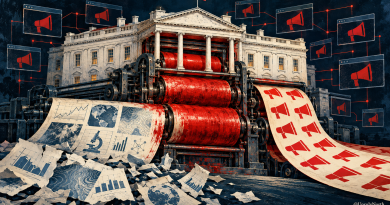
The American Dividend • Part I of The Price of Power
America did not rebuild Europe out of charity. The postwar order created markets, investment, dollar demand, defence sales and political influence that enriched the United States for generations. Before asking what America paid, it is worth asking what America gained. That return reshaped the world.

For decades, the American relationship with Europe has often been described in the United States as an exercise in generosity. America rebuilt Europe. America defended Europe. America guaranteed the sea lanes, stationed troops across the continent and underwrote an international system from which Europeans supposedly received security and prosperity at American expense.
There is truth in the first half of that history. The United States spent enormous sums after the Second World War, accepted military obligations that carried real costs and provided capabilities its allies could not have reproduced on their own.
The mistake is treating those expenditures as charity.
The postwar system was one of the most successful strategic investments the United States ever made. It helped transform a devastated Western Europe into an enormous market for American goods, a destination for American capital, a source of investment into the United States and a collection of allies whose economies operated inside an international financial and trading system in which the United States occupied the most advantageous position.
The architects of that system were remarkably candid about what they were doing. They did not generally argue that American interests should be sacrificed for European prosperity. They argued that European prosperity was an American interest.
That distinction matters now because the economic value of American leadership has become obscured by a political vocabulary of burden, freeloading and tribute. If the United States wants to understand what it risks losing when allies begin reducing their dependence on it, it first has to remember what that dependence has been worth.
Reconstruction Was an Investment
Europe emerged from the Second World War physically and economically shattered. Industrial infrastructure had been destroyed, transportation networks disrupted, currencies weakened and governments confronted shortages of food, fuel, machinery and dollars.
The United States faced the opposite problem. Its industrial base had expanded dramatically during the war. American factories, agriculture and finance emerged in a position of extraordinary strength, but foreign customers needed the means to buy what the United States could produce.
George Marshall understood the connection.
When he proposed what became the European Recovery Program in June 1947, he warned that Europe’s need for imported food and essential goods—much of it available from the United States—far exceeded its ability to pay. He also told his American audience that the consequences of European economic collapse for the United States “should be apparent to all.”
Congress eventually appropriated $13.3 billion for European recovery between 1948 and 1952. The money helped restore production, finance imports and provide the capital necessary to rebuild functioning European economies.
It was an extraordinary act of statecraft. It was humanitarian. It was intended to stabilize democratic governments threatened by economic desperation and Communist political movements. It was also intended to advance American economic interests.
The U.S. National Archives says so explicitly: the Marshall Plan provided markets for American goods and created reliable trading partners. The State Department’s own historical account similarly describes it as a stimulant to the U.S. economy because it established markets for American products.
There is no contradiction there.
A prosperous customer is worth more than an impoverished dependent.
That principle was fundamental to the American strategy. Washington was spending money to create an economic environment in which trade could resume, currencies could stabilize, businesses could invest and European countries could once again purchase American products without emergency assistance.
The policy was therefore more sophisticated than simple aid. America was financing the recovery of countries that it expected eventually to stop needing American aid precisely because functioning, prosperous economies would become more valuable partners.
The Marshall Plan was designed to end.
The commercial relationships it helped restore were not.
America Helped Write the Rules
The recovery program was only one component of a much larger architecture.
Even before the Second World War had ended, representatives of 44 countries met at Bretton Woods, New Hampshire, in July 1944 to design the foundations of the postwar financial system. The conference created the International Monetary Fund and what became the World Bank. The system of fixed exchange rates that followed was organized around gold and the U.S. dollar, with other currencies generally maintaining their values against the dollar while Washington maintained dollar convertibility into gold.
This was international cooperation, not simply an American decree. Britain, Canada and dozens of other countries participated, and Europeans had their own interests and proposals.
But there was no ambiguity about where economic gravity had shifted.
The United States entered the postwar period with vast industrial capacity, enormous gold holdings and a currency capable of functioning at the centre of the reconstructed system. Bretton Woods formalized that reality.
Trade policy followed the same general logic.
The General Agreement on Tariffs and Trade, signed by 23 countries in 1947, established rules intended to reduce tariffs, constrain discriminatory trade practices and expand international commerce. The original negotiations produced approximately 45,000 tariff concessions affecting around $10 billion in trade. The World Trade Organization’s history notes that the United States itself pushed for rapid negotiation of a multilateral tariff agreement while the broader postwar trade architecture was still being debated.
Again, the arrangement benefited many countries. Western Europe desperately needed markets of its own. Canadian exporters benefited. Japan eventually prospered within the system. International commerce expanded on a scale that could not be reduced to a single country’s interests.
But the United States was hardly a passive benefactor.
An international economy characterized by lower barriers, stable currencies and rising consumer demand was exceptionally favourable to the world’s dominant industrial and financial power.
America helped build an open trading system because America was extraordinarily well positioned to trade within it.
Washington Wanted a Stronger Europe
Even European integration, sometimes presented today as a counterweight to American power, received sustained political support from Washington during its formative decades.
Declassified State Department records show that by the 1950s the United States openly favoured greater Western European economic integration. American policymakers supported institutions such as the European Coal and Steel Community because they believed integration would strengthen Europe, bind West Germany into a durable Western political structure and make the Atlantic alliance more stable.
That policy was not irrationally altruistic.
A collection of economically weak European states perpetually requiring American assistance would have been an expensive strategic liability. A prosperous, increasingly integrated Western Europe could trade, invest, contribute to its own defence and resist Soviet pressure.
The United States did not need Europe to remain poor in order to remain powerful.
For much of the postwar era, the opposite was true.
American primacy worked because other countries became richer inside a system in which American institutions, currency, companies and security relationships remained central.
NATO Was Part of the Economic Architecture
The North Atlantic Treaty of 1949 is normally discussed as a military arrangement, but American officials at the time explicitly connected security with economic recovery.
A State Department statement issued shortly before the treaty was signed described NATO and the European Recovery Program as complementary. Economic recovery required security, while a viable security alliance ultimately required successful economic recovery.
That relationship is important because the modern argument that America simply “paid for Europe’s defence” compresses several very different things into one political slogan.
The United States certainly spent—and continues to spend—far more on its military than any European NATO country. It maintained troops, aircraft, ships, nuclear forces, logistics, intelligence systems and bases necessary to execute American global strategy as well as defend allies.
But the Pentagon budget was never simply a transfer payment to Europe.
The American military existed to serve American national interests across Europe, Asia, the Middle East, the Pacific and elsewhere. Its presence in Europe deterred the Soviet Union, protected allied states and simultaneously gave Washington extraordinary strategic reach into Eurasia.
Security also created the stable environment in which the transatlantic economy flourished.
And over time, the military relationship produced something else: European armed forces became major customers of the American defence industry.
Between 2021 and 2025, Europe accounted for 38 percent of U.S. major-arms exports, according to the Stockholm International Peace Research Institute. U.S. arms transfers to Europe were 217 percent higher than during 2016–20, while the United States supplied 58 percent of major arms imported by European NATO members. Some of that transfer volume was military aid to Ukraine rather than commercial sales, so it should not be confused with pure revenue. But the broader relationship between alliance integration, common military standards and American defence exports is unmistakable.
That deserves its own examination. For now, the important point is simpler.
American security leadership was expensive.
It was also economically and strategically valuable.
The Dollar Became an American Asset
No part of the postwar settlement produced a more persistent economic advantage than the international role of the dollar.
The original Bretton Woods exchange-rate system eventually collapsed after the United States ended dollar-gold convertibility in 1971. Yet the dollar did not disappear from the centre of global finance. Its role endured through trade invoicing, international banking, debt markets, central-bank reserves and the enormous market for U.S. Treasury securities.
The Federal Reserve is unusually direct about what this means for Americans.
Governor Christopher Waller has explained that the dollar’s international role lowers borrowing and transaction costs for U.S. households, businesses and government, enlarges the pool of investors willing to finance American borrowers and reduces exchange-rate risk for U.S. companies. Foreign demand for Treasury securities raises their prices and therefore reduces the interest expense paid by the U.S. government.
That is an extraordinary privilege.
When companies elsewhere conduct business in dollars, American companies can often operate internationally without assuming the same currency risk as their competitors.
When central banks accumulate dollar reserves, much of that money finds its way into dollar-denominated assets.
When international investors seek liquid markets during periods of uncertainty, they frequently purchase American securities.
The benefit does not appear as an annual cheque labelled “payment for American leadership.” It is embedded in financing costs, capital markets, exchange rates and financial demand.
And it remains substantial.
According to the International Monetary Fund’s latest data, the dollar represented 56.7 percent of disclosed global foreign-exchange reserves in the second quarter of 2026. Its share has declined from earlier peaks, but it remains dominant by a wide margin.
Reserve-currency status is not a gift Europe bestowed upon the United States. The dollar remains dominant because the American economy and capital markets offer a combination of scale, liquidity and institutional depth that competitors have struggled to match.
But international confidence matters.
The system generates enormous advantages precisely because foreigners remain willing to participate in it.
Europe Became Enormously Valuable to America
The ultimate measure of the postwar relationship is not what Washington spent in 1948.
It is what the transatlantic economy became.
In 2025, U.S. trade in goods and services with the European Union reached approximately $1.6 trillion. American goods exports to the EU were roughly $412.5 billion, while services exports reached approximately $324.8 billion.
The politically familiar number is the American goods deficit with Europe, which reached approximately $220 billion.
But concentrating exclusively on goods produces an incomplete picture.
The United States simultaneously ran a $107.3 billion surplus in services trade with the EU in 2025. American companies sell Europe financial services, technology, intellectual property, consulting, transportation and other services that disappear when trade is reduced to the number of physical objects crossing a port.
Investment reveals an even deeper relationship.
At the end of 2025, Europe accounted for approximately 60 percent of the entire U.S. direct-investment position abroad and 64 percent of foreign direct investment in the United States. Europe was simultaneously America’s largest destination for direct investment and its largest source.
Those numbers are difficult to reconcile with the idea that the transatlantic relationship is fundamentally an American subsidy to Europe.
American companies have invested trillions across Europe because they make money there.
European companies have invested trillions in the United States because they make money there.
American firms use European economies as markets, production centres, financial hubs and gateways to a wealthy consumer base. European capital finances factories, businesses and employment inside the United States.
This is not dependence running in one direction.
It is an extraordinarily dense economic network.
The reason American primacy mattered is that the United States occupied the most advantageous position within much of that network.
Hegemony Was Never Free
None of this means American leadership carried no cost.
It did.
The United States maintained forces overseas, accepted treaty obligations, spent heavily on defence, provided foreign assistance and periodically carried larger military burdens than many of its partners.
There were genuine disputes over burden sharing. European countries did allow military capacity to deteriorate after the Cold War. Washington’s complaints about inadequate European defence spending predate Donald Trump by decades and were voiced by Democratic and Republican administrations alike.
Nor should the postwar system be romanticized.
American governments frequently used economic leverage aggressively. U.S. policy was shaped by domestic corporate interests as well as broader strategic objectives. European governments did not always agree with Washington and periodically resisted American pressure. France withdrew from NATO’s integrated military command in 1966 before returning decades later. Trade disputes were hardly invented in the twenty-first century.
The system worked not because everybody always agreed, but because enough countries concluded that participation remained more valuable than withdrawal.
That is the important measurement.
The United States paid for military capabilities and international responsibilities, but received things in return that do not appear in a simple defence-spending comparison: access, influence, markets, investment, demand for its currency, lower financing costs, defence contracts, intelligence cooperation, diplomatic support and the ability to shape many of the rules under which international commerce operated.
That is what hegemony looked like in practical economic terms.
Not an empire receiving tribute.
Not a charity feeding dependants.
A system in which the country occupying the centre received disproportionate advantages from keeping the system functioning.
The Dividend
The generation that constructed the postwar order understood something that much of today’s political argument has forgotten.
Power is more valuable when other countries willingly organize important parts of their economies around it.
The Marshall Plan did not merely rebuild buildings and factories. It rebuilt customers.
Trade liberalization did not merely lower European tariffs. It expanded the international market available to American corporations.
Bretton Woods did not merely stabilize currencies. It placed the dollar near the centre of the world’s financial machinery.
NATO did not merely defend Europe. It anchored the United States militarily and politically inside the continent while helping create enduring relationships between European governments and American defence suppliers.
European integration did not simply create a competitor. It created an increasingly wealthy, stable market with which American companies and investors became deeply intertwined.
The result can still be measured eight decades later: a $1.6 trillion annual U.S.-EU trade relationship, Europe accounting for most American direct investment abroad, trillions flowing in the opposite direction into the United States and a dollar that remains the world’s principal reserve currency.
The postwar order was therefore never adequately described by asking how much America paid.
The better question is what America received.
For generations, the answer was enormous.
That history becomes especially important when the United States begins treating alliances primarily as unpaid bills and economic relationships primarily as sources of leverage. The systems Washington inherited were valuable precisely because other countries were willing to depend upon them.
If that willingness begins to change, the cost will not be measured only in diplomatic goodwill.
It will be measured in contracts that go elsewhere, investments that diversify, currencies that gain market share, defence industries that rebuild outside the United States and governments that construct alternatives to institutions Americans once assumed they would always dominate.
Before examining that process, however, one fact has to be established clearly.
Europe was never simply an expense on America’s balance sheet.
For most of the postwar era, it was one of America’s most valuable assets.
Sources
- U.S. National Archives — The Marshall Plan (1948) — the program’s cost, purpose and explicit economic benefits to the United States.
- U.S. Department of State, Office of the Historian — Marshall Plan, 1948 — European recovery, U.S. strategic objectives and the creation of markets for American goods.
- Federal Reserve — The Dollar’s International Role — the financial advantages the dollar’s international position provides to American households, companies and government.
- U.S. Bureau of Economic Analysis — Direct Investment by Country and Industry, 2025 — current U.S. outward and inward investment positions.
- Office of the U.S. Trade Representative — European Union Trade Summary — current U.S.-EU goods and services trade.
- International Monetary Fund — Currency Composition of Official Foreign Exchange Reserves, Q2 2026 — current dollar share of global reserves.
- SIPRI — Trends in International Arms Transfers, 2025 — recent U.S. arms transfers to Europe and European NATO procurement dependence.