Trump’s New Manifest Destiny
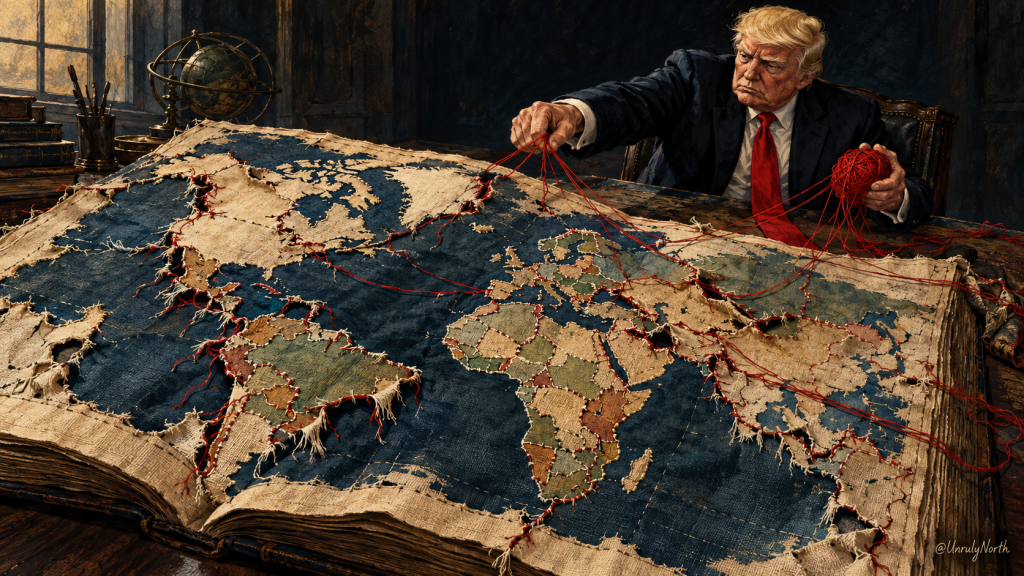
Trump’s new Manifest Destiny treats other nations’ sovereignty as conditional. From annexation threats against Canada and Greenland to economic siege, military intervention and control over resources, this administration is asserting an imperial right to decide what other nations may call their own.
When American forces seized Nicolás Maduro in January 2026, Donald Trump announced that the United States would run Venezuela through a political transition. Within days, Washington was selling Venezuelan oil and directing the proceeds into American-controlled accounts. The intervention gave concrete meaning to threats that other governments had been encouraged to dismiss as bluster. Trump had demonstrated that he would use military force to remove a foreign leader and then claim authority over the country’s future. www.un.org
But Venezuela is one part of a much larger campaign. Canada has faced demands for territorial absorption linked explicitly to economic force. Greenland has faced acquisition threats and economic punishment directed at European governments defending its sovereignty. Panama has been told to change its foreign relationships or face American action. Cuba has been squeezed through its energy supply, Mexico and Colombia threatened with military intervention, and Gaza discussed as property Washington could acquire while its Palestinian population was moved elsewhere.
These are different applications of the same imperial principle: American interests are treated as superior to other peoples’ rights to govern themselves. Some demands have been resisted, others withdrawn, and some converted into agreements short of Trump’s original ambitions. Their differing outcomes do not obscure the governing assumption. Washington claims full sovereignty for itself while reserving the right to determine how much independence everyone else may exercise.
Canada: economic punishment with annexation as the escape
Canada exposes the territorial ambition with unusual clarity. In January 2025, Trump was asked whether he would use military force to make Canada part of the United States. He answered with “economic force,” dismissed the border as an “artificially drawn line,” and connected its removal to American security. Canada’s existence was being discussed as an inconvenience that economic pressure might overcome. toronto.citynews.ca
The connection between tariffs and annexation became more explicit in March. In a post announcing an escalation against Canadian steel and aluminum, Trump again proposed Canadian statehood and said that joining the United States would make the tariffs disappear. This was not simply a trade dispute accompanied by an unrelated joke. He presented surrendering national independence as a remedy for punishment he was threatening to impose. The Jerusalem Post
At his May meeting with Mark Carney, Trump was directly asked whether he had been joking about making Canada the fifty-first state. He said he still believed in it. He described the combined countries in the language of a property developer, admiring their appearance without the border. When Carney said Canada was not for sale, Trump replied, “Never say never.” Roll Call
Canada remained independent because Canadians rejected the proposition, not because Trump had never advanced it. His willingness to contemplate a negotiated decision does not erase his earlier threat of economic force. Consent obtained by making independence economically painful is not the same as a population freely deciding its constitutional future.
This is the modern territorial logic of Manifest Destiny: an existing country becomes something America would look better, feel safer or become richer by absorbing. Its people’s refusal is treated as an obstacle to a desirable transaction. The language of friendship only makes the coercion more grotesque when the target is a longstanding ally.
Greenland: pressure against an entire alliance
In Greenland, Trump’s acquisition campaign expanded into a confrontation with European governments. His refusal to rule out military or economic force challenged both the sovereignty of Denmark, a NATO ally, and the right of Greenlanders to determine their own future. The United States already operated Pituffik Space Base under an established defence relationship. Security cooperation existed; ownership was the additional demand. www.reuters.com
On January 17, 2026, Trump threatened additional tariffs against Denmark, Norway, Sweden, France, Germany, the Netherlands, Finland and Britain until the United States was allowed to acquire Greenland. Economic punishment would therefore reach beyond the territory’s own government to countries standing alongside it. The message was that defending another ally’s sovereignty could carry a commercial penalty imposed by the alliance’s most powerful member. investing.com
Trump withdrew those tariff threats four days later and ruled out using force at Davos. That retreat matters: the threatened tariffs did not become the completed policy. But his accompanying warning retained the coercive premise: “You can say yes, and we will be very appreciative, or you can say no, and we will remember.” A refusal remained something for which other governments might eventually pay. investing.com
The September agreement preserved Danish sovereignty and Greenlandic self-determination while providing for expanded American access and additional defence areas at Narsarsuaq and Mestersvig. It also restricts certain foreign investments and non-NATO military activity. Its provisions contemplate an independent Greenland remaining in NATO and assuming the agreement’s obligations. Entry into force depends on completion of the required parliamentary procedures. These are consequential commitments, not an American purchase of the island. www.whitehouse.gov
Greenlandic leaders negotiated, resisted annexation and welcomed the outcome. Their agency should not be erased to make Trump appear omnipotent. Nevertheless, the episode demonstrates how territorial threats can push existing security relationships towards expanded American privileges. It also exposes the weakness of the claim that acquisition was indispensable: an agreement preserving Greenland’s political rights could address defence requirements all along.
Panama: a sovereign country reduced to strategic geography
Trump’s promise to take back the Panama Canal rested partly on a false description of who controlled it. Chinese-linked companies’ involvement in nearby ports did not mean China operated the canal. Panama did. Yet Trump invoked Chinese control to justify reclaiming a waterway transferred to Panama under treaty arrangements. His refusal to exclude military action turned a dispute over commercial influence into a threat against a sovereign country. www.reuters.com
The pressure extended beyond presidential speeches. During Marco Rubio’s February 2025 visit, the State Department told Panama that its existing arrangements were unacceptable and that, without immediate changes, the United States would take measures to protect its claimed treaty rights. President José Raúl Mulino subsequently announced that Panama would not renew its participation in China’s Belt and Road Initiative. Washington was using the canal dispute to reshape Panama’s wider international relationships. state.gov
Further security agreements expanded American military access and training. Panama insisted that the facilities remained under Panamanian control, that the arrangements did not establish permanent American bases, and that its sovereignty remained intact. Hegseth nevertheless described the effort as taking the canal back from Chinese influence. www.reuters.com
The distinction between the canal and neighbouring ports is central to understanding the manipulation. A commercial presence became a claim of foreign domination; that claim then supported demands for American intervention. Panama was expected to reorganize its affairs to satisfy Washington’s assessment of acceptable partners. In this hierarchy, smaller states possess a right to choose their relationships only when the dominant power approves the choice.
Cuba: deprivation as an instrument of political control
Cuba demonstrates how imperial pressure can operate without a territorial demand. Trump’s January 2026 executive order established a mechanism for penalizing countries that supplied the island with oil. Washington was not merely restricting its own commerce. It was threatening other governments for trading with a third country, extending American policy through the leverage of access to the American market. www.whitehouse.gov
The resulting restrictions have intensified severe fuel shortages and blackouts. Reuters has documented how electricity failures disrupt water pumping, sanitation and refrigeration. Cuba’s aging infrastructure and economic mismanagement predate this campaign, but an existing crisis does not absolve a government that deliberately makes it worse. The people losing power, water and functioning services are not abstractions in a negotiation. www.reuters.com
The administration has openly sought fundamental political change in Cuba. In September, Trump said he expected an agreement and did not think military action would be necessary. That is consistent with a strategy intended to secure political concessions through economic exhaustion. The absence of an invasion does not make coercion disappear; it changes the mechanism by which compliance is pursued. www.reuters.com
Nor has the blockade been completely impermeable. Washington has allowed exceptions, including fuel exports to eligible private businesses and a Russian oil shipment. Those exceptions reveal the discretion being asserted: the American government decides which channels may remain open and under what conditions. Cuba’s access to essential energy becomes an instrument for restructuring its political economy from outside. www.reuters.com
Cuban citizens have a right to oppose their government and demand political freedom. That right belongs to them. It does not authorize Trump to make their daily survival contingent on the political outcome Washington prefers.
Mexico and Colombia: the border as an optional restraint
For Mexico, Trump’s repeated proposals for military action challenge whether an allied government can refuse American forces entry. In November 2025, he endorsed possible strikes against cartels inside Mexico and declined to answer whether he would require Mexican permission. Claudia Sheinbaum repeatedly rejected intervention, distinguishing cooperation and intelligence sharing from foreign military operations on Mexican territory. english.elpais.com
That distinction is fundamental. Mexico can cooperate against organized crime without conceding that Washington may decide when Mexican sovereignty becomes inconvenient. Rubio publicly ruled out unilateral intervention, and Sheinbaum continued to reject Trump’s offers. The administration’s contradictory statements therefore should not be flattened into a claim that an invasion had been ordered. They show a president repeatedly testing a boundary that his counterpart had already made clear. www.reuters.com
Colombia received a related warning. Trump discussed striking cocaine-production facilities in November 2025. Days after Maduro’s capture, when asked about a military operation against Colombia, he said it “sounds good to me.” These remarks were directed at Colombia under Gustavo Petro. They were threats, not completed operations, but their timing gave them a force that ordinary diplomatic criticism does not possess. www.reuters.com
Drug trafficking is a serious transnational problem. It does not turn every country through which drugs move into territory available for unilateral American attack. If criminal activity alone entitled powerful states to cross borders and choose military targets, the prohibition on intervention would become meaningless. Trump’s approach makes his assessment of another government’s performance the potential trigger for disregarding its refusal.
Taken together, Mexico and Colombia demonstrate the policing function of the emerging doctrine. Washington claims the role of evaluator, issues demands and leaves military enforcement hanging over governments judged insufficiently compliant.
Gaza: inhabitants displaced by the ownership claim
Gaza exposes the proprietary mentality with particular brutality. In February 2025, Trump proposed American ownership of the territory while its Palestinian inhabitants were relocated elsewhere. His administration described reconstruction and improved housing, but Trump’s own statements went considerably further than temporary evacuation. Asked whether Palestinians would have a right to return under his proposal, he said they would not. investing.com
That denial is central. A reconstruction proposal serves a population by rebuilding its homes and restoring its ability to live there. A proposal that removes the population, denies its return and places the territory under foreign ownership makes reconstruction a vehicle for dispossession. Promising better housing elsewhere does not extinguish people’s rights to their homeland.
Egypt, Jordan and other Arab governments rejected the displacement scheme. Their refusal mattered both to Palestinians and to their own sovereignty: neighbouring countries were being assigned responsibility for absorbing the human consequences of a territorial project conceived in Washington. Trump’s plan did not become an American annexation, but its failure does not sanitize what he proposed. www.reuters.com
The language also reveals whose decisions were considered important. Washington would determine ownership; outside governments would provide destinations and funding; Palestinians would be expected to accept the future arranged for them. A people with political rights was recast as a population to be relocated around a development plan.
Gaza belongs in this argument because it demonstrates that the underlying entitlement extends beyond the Americas. Territory becomes something a powerful outsider can possess, and the people living on it become a practical problem to be managed.
An empire does not need to annex everything
Venezuela shows how military intervention and economic control can reinforce one another without formal annexation. Following Maduro’s removal, Washington controlled accounts holding proceeds from initial oil sales. Later, Trump announced an arrangement he described as majority American control over 65 billion barrels of reserves. Its commercial and legal structure raised substantial questions, while the promised investment remained a future prospect. But the sequence was clear: force changed the political circumstances in which control over strategic resources was negotiated. www.reuters.com
Across these cases, the demands vary: territory, military access, political change, commercial exclusion, resource privileges or permission to intervene. The common objective is the ability to determine choices that should belong to another people. Imperialism can work through a nominally independent government as readily as through a colonial governor.
The historical framework is explicit in the administration’s own documents. Its 2025 National Security Strategy establishes a Trump Corollary to the Monroe Doctrine, promising American pre-eminence and restrictions on outside competitors’ control of strategically important assets in the hemisphere. In July 2026, Colby promoted the “Donroe Doctrine” while discussing the administration’s military campaign and Maduro’s removal. www.whitehouse.gov
Manifest Destiny supplies the territorial tradition: American expansion presented as a national entitlement over lands already inhabited and governed by others. The Roosevelt Corollary supplies the interventionist tradition: the United States claiming a regional policing role. The State Department’s historical account identifies that corollary as a justification for interventions in Cuba, Nicaragua, Haiti and the Dominican Republic. www.loc.gov
Trump’s version combines both with modern financial and commercial pressure. He did not invent these instruments or America’s history of using them. He is reviving their imperial logic and presenting it as national renewal.
The rule Trump wants to replace
The UN Charter establishes sovereign equality and prohibits threats or force against another state’s territorial integrity or political independence. The Organization of American States Charter goes further on economic coercion, rejecting measures designed to force another state’s sovereign will and obtain advantages. These standards protect weaker states precisely when a stronger neighbour believes it has compelling reasons to interfere. www.un.org
A security interest does not automatically authorize acquisition, intervention or political control. Nor does another government’s repression transfer its population’s right of self-determination to Washington. Otherwise every aggressive power could manufacture its own exception by declaring a neighbour dangerous, badly governed or improperly aligned.
Trump’s method is tyrannical because it substitutes superior power for reciprocal restraint. He claims the authority to decide which borders deserve respect, which refusals deserve punishment and which political outcomes other populations should accept. The smaller state is expected to negotiate under conditions the stronger state can worsen at will.
The consequences reach well beyond his immediate targets. Washington cannot credibly insist that Russia respect Ukraine’s sovereignty while claiming discretionary authority to remove governments elsewhere. It cannot defend the principle that Taiwan’s future must be free from coercion while threatening economic punishment to acquire Greenland. The situations are different; the need for a rule constraining great powers is shared.
Trump’s conduct gives America’s rivals material for their own propaganda, but the deeper damage is to countries caught between them. A world divided into spheres of influence leaves those countries with fewer protections against every dominant neighbour, not merely the United States.
Canada’s independence, Greenlandic self-determination, Panamanian control of its canal and Palestinians’ right to remain in their homeland do not depend on American approval. Neither do the peoples of Cuba, Mexico, Colombia and Venezuela forfeit their political rights when Washington invokes drugs, security or economic development. Defending those rights consistently is what prevents sovereignty from becoming a privilege granted by an empire.
Sources
- Reuters: Trump’s economic-force threat against Canada
- Reuters: Tariff threats against European countries over Greenland
- Reuters: Chronology of Trump’s Gaza ownership and displacement proposals
- White House: Cuba oil-supplier tariff order
- White House: 2025 National Security Strategy
- United Nations Charter and Organization of American States Charter