
Europe Buys Back Its Autonomy • Part IV of The Price of Power
Europe is spending more on defence, but the bigger shift is where that money goes. New EU rules, joint procurement and industrial policy are steering billions toward European factories, technology and supply chains, reducing reliance on U.S. weapons while preserving the alliance. The balance shifts.
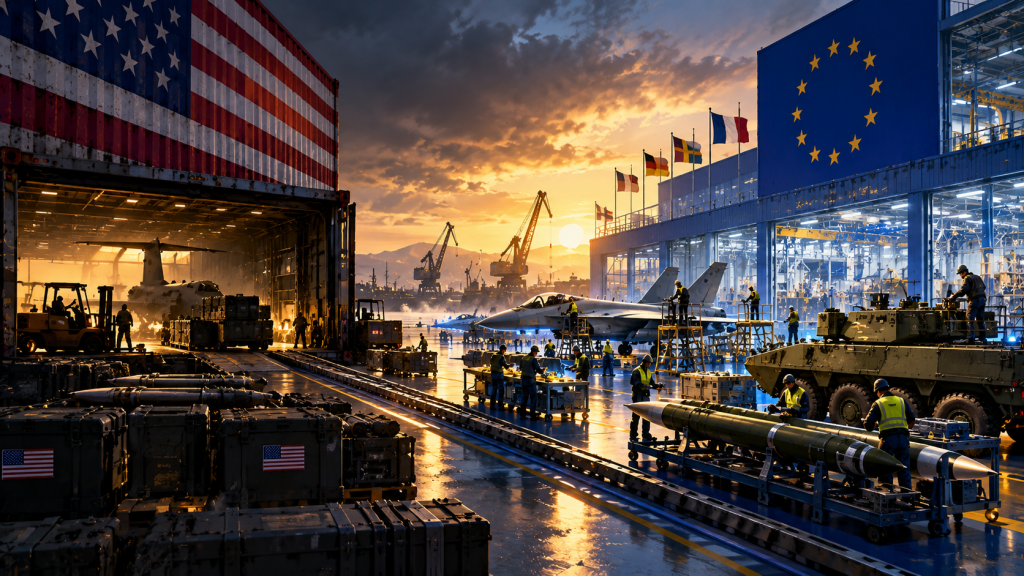
Europe’s military problem is no longer simply that it spends too little. The harder question is what happens to the money after governments decide to spend it.
For years, European states cut defence budgets, reduced production capacity and bought equipment largely through national procurement systems. When Russia invaded Ukraine in 2022, governments had to rebuild military capability quickly. Much of the immediate demand went outside Europe because European factories could not supply enough equipment at the required speed.
The result exposed another form of dependence.
A study cited by the European Commission found that 78 per cent of EU defence acquisitions between the start of Russia’s full-scale invasion and June 2023 came from outside the European Union. The United States alone accounted for 63 per cent. Only 18 per cent of EU equipment spending in 2022 involved collaborative European procurement, far below the bloc’s long-standing target. (consilium.europa.eu)
Europe was spending more on defence, but much of the industrial benefit was leaving Europe.
That is now beginning to change. The European Union is building funding rules, procurement incentives and joint industrial projects designed to keep more defence spending inside Europe. The objective is not to sever the transatlantic alliance or remove American companies from the market. Europe still depends heavily on U.S. aircraft, air defence, intelligence and other systems.
Instead, the goal is to ensure that higher defence spending also creates European factories, European supply chains and European control over the technologies on which European security depends.
In practical terms, Europe is trying to buy back some of the autonomy it allowed to disappear.
Rearmament Exposed the Dependency
Europe’s dependence on foreign weapons became deeper just as governments began talking more seriously about strategic autonomy.
According to the Stockholm International Peace Research Institute, arms imports by European states increased by 210 per cent between 2016–20 and 2021–25. The United States supplied 48 per cent of all major arms imported by European countries during the latter period. Among European NATO members, the American share was even higher at 58 per cent. (sipri.org)
That dependence had understandable causes. European governments suddenly needed combat aircraft, air defence systems, ammunition and other equipment while facing the largest land war on the continent in generations. American industry already produced many of those systems at scale.
The problem was that emergency purchases also reinforced the very dependence European governments said they wanted to reduce.
An imported weapons system does not end with delivery. Armed forces need ammunition, spare parts, software updates, training, maintenance and future upgrades. Some systems remain in service for thirty or forty years. The original procurement decision can therefore shape military relationships for decades.
Europe’s defence debate has increasingly moved beyond the question of whether a weapon works. Governments are also asking who controls its production, whether spare parts can be obtained during a crisis, whether software can be modified without foreign approval and whether the supplier will remain politically reliable throughout the life of the system.
Russia created the urgency behind this reassessment. Uncertainty about future U.S. policy has added another reason to act.
SIPRI noted this year that concerns about Russia, combined with questions about Washington’s long-term commitment to European defence, have increased demand for weapons while strengthening interest in European self-reliance. (sipri.org)
Europe has therefore reached an uncomfortable conclusion. Spending more is not enough if the spending merely replaces one capability gap with another dependency.
Europe Begins Attaching Conditions to the Money
The clearest change is visible in the rules attached to new European defence funding.
The EU’s Security Action for Europe programme, known as SAFE, provides up to €150 billion in loans for defence investment. Eighteen national plans have been approved, and more than €12 billion has already been disbursed. The programme encourages joint procurement and is intended to strengthen Europe’s industrial base as well as its military capability. (commission.europa.eu)
The important part is where the money can go.
SAFE rules require at least 65 per cent of component costs to come from the European Union, European Economic Area countries or Ukraine. That does not shut American companies out completely, but it changes the incentive. A company that wants access to European-backed spending has a reason to produce more of the system inside Europe or work with European partners. (commission.europa.eu)
The European Defence Industry Programme, or EDIP, goes further. Companies receiving financial support generally must be established in the EU, use European infrastructure and resources, and keep design authority for eligible products in Europe. At least 65 per cent of component costs must come from the EU or associated countries. (consilium.europa.eu)
That requirement is more important than it may first appear.
Design authority determines who controls how a weapon can be developed, altered and upgraded. A country can assemble equipment domestically and still depend on a foreign company for critical design decisions. By attaching funding to European control, the EU is trying to prevent local assembly from becoming a cosmetic substitute for genuine industrial capability.
The policy is therefore not only about jobs.
It is about control.
The Money Is Moving Toward Production
The European Defence Industry Programme now has a €1.5 billion work programme for 2026–27. More than €700 million is directed toward expanding production capacity for products such as missiles, ammunition, explosives, electronic components and counter-drone systems. Another €240 million supports joint procurement, while €325 million is allocated to large collaborative projects of common European interest. (defence-industry-space.ec.europa.eu)
Those numbers are small beside national defence budgets, but the purpose of EDIP is not to replace national spending. It is to change how that spending behaves.
EU money can make a multinational project more attractive, help manufacturers expand factories and reduce the financial penalty that countries face when they try to buy together. The Commission wants larger and more predictable orders to give industry enough confidence to invest in additional production capacity.
There is evidence that companies are responding. The first EDIP call for expanded production of energetic materials, including propellants and explosives, attracted 83 proposals from companies across 23 EU member states and Norway. The Commission has allocated more than €165 million to that call and expects industry co-financing to raise the potential investment to about €470 million. (defence-industry-space.ec.europa.eu)
This addresses one of Europe’s most basic defence weaknesses. Governments cannot suddenly demand millions of additional shells or missiles and expect factories to appear overnight. Production lines require machinery, skilled workers, suppliers and long-term contracts.
During the first years of the Ukraine war, Europe often discovered that political promises could be made much faster than weapons could be manufactured.
Industrial autonomy therefore requires something less dramatic than a new fighter aircraft but just as important: factories with enough orders to remain open when a crisis is not already underway.
Europe Has Put Targets on the Strategy
The shift is not limited to individual funding programmes.
The European Defence Industrial Strategy set explicit targets for changing how member states buy military equipment. By 2030, the Commission wants at least 40 per cent of defence equipment to be procured collaboratively. It also wants at least 50 per cent of member states’ defence procurement budgets spent within the European defence industrial base by that year, rising to 60 per cent by 2035. (defence-industry-space.ec.europa.eu)
These are political targets rather than guarantees. National governments still make most procurement decisions, and they regularly choose national priorities over European coordination.
That fragmentation has long weakened Europe’s defence industry. Different governments maintain different requirements, order small quantities and support separate national suppliers. Manufacturers then struggle to achieve the scale available to large American producers.
The EU is trying to reverse that pattern by aggregating demand.
Instead of several governments separately buying small numbers of similar systems, Brussels wants countries to define common requirements and order together. Larger contracts can reduce unit costs, improve interoperability and give European manufacturers a clearer reason to expand production.
The approach is already becoming more concrete. Earlier European joint-procurement programmes supported projects in air and missile defence, ammunition and military platforms. The Commission says the €300 million EDIRPA programme helped support more than €11 billion in common procurement by participating states. (defence-industry-space.ec.europa.eu)
The European market is still fragmented, but governments are beginning to build institutions that can make fragmentation more expensive and cooperation easier.
Five Projects Show Where Europe Wants to Go
On September 28, EU governments approved the first five European Defence Projects of Common Interest.
The projects cover drones and counter-drone systems, maritime and seabed defence, military space capability, integrated air and missile defence, and protection of Europe’s eastern flank. They are intended for projects that are too expensive or complex for individual countries to pursue efficiently on their own. (consilium.europa.eu)
The choice of sectors is revealing.
Europe does not simply want to produce more tanks and artillery shells. It is trying to strengthen areas that determine whether a military can operate independently: early warning, satellites, command networks, air defence, drones and maritime surveillance.
These are systems that connect other systems together.
The space project includes missile-warning satellites, secure communications, intelligence and surveillance, positioning systems and the ability to replace satellites quickly. The integrated air and missile defence project is designed to connect early warning with command and defensive weapons. The maritime project includes the protection of seabed infrastructure such as cables.
This is a more ambitious form of autonomy than buying domestically produced ammunition.
It is an effort to own more of the architecture on which military operations depend.
GlobalEye Shows What the Shift Can Look Like
One of the clearest recent examples came not from the European Union but from NATO itself.
In July, eleven NATO members announced a joint purchase of up to ten Saab GlobalEye surveillance aircraft to replace part of NATO’s ageing Boeing E-3 airborne warning fleet. The participating countries include Germany, the Netherlands, Norway, Denmark, Sweden and several other European allies, along with Canada. (nato.int)
The decision should not be portrayed as NATO rejecting American industry. NATO describes the project as transatlantic cooperation, with European and Canadian companies leading the programme while American firms remain important suppliers. The GlobalEye itself uses Bombardier’s Canadian-built Global aircraft as its platform. (nato.int)
Yet the industrial shift is still significant.
A capability previously centred on Boeing aircraft will now be led by Saab and Bombardier. Reuters reported that European demands for greater industrial sovereignty have also pushed major U.S. defence companies to offer more local production, technology partnerships and European manufacturing. Lockheed Martin, RTX and Anduril are among the companies adapting their European strategies. (reuters.com)
That response may be one of the clearest signs that European policy is beginning to change the market.
Europe does not need to ban American companies to gain more control. It can use the purchasing power of a rapidly expanding defence market to demand that more production, technology and employment remain in Europe.
American companies can still win contracts.
The terms of those contracts may become less American.
This Is Not Defence Independence Yet
Europe remains far from military self-sufficiency.
The United States still supplies capabilities that European governments cannot replace quickly. American combat aircraft remain central to several European air forces. Patriot air defence systems have few direct substitutes at the same scale. U.S. intelligence, surveillance, logistics and nuclear capabilities continue to play major roles in European security.
SIPRI’s latest figures make that dependence clear. The United States supplied 58 per cent of major arms imported by European NATO states in 2021–25. European manufacturers increased output during the same period, but they did not prevent American suppliers from expanding their position in the market. (sipri.org)
Europe also faces internal competition. Governments frequently want European procurement until another European country’s manufacturer wins the contract. France, Germany, Italy, Sweden and other producers have their own industrial interests, while eastern members often place greater weight on rapid delivery and close relations with Washington.
Those tensions will not disappear because Brussels creates another fund.
Nor should autonomy become an excuse to purchase an inferior product simply because it carries a European label. A defence industry that survives only behind political protection would leave Europe paying more for weaker capability.
The stronger case for European production is therefore based on capacity rather than nationality alone. Europe needs enough industrial depth to make independent choices when circumstances require them.
That means competition, scale and reliable supply matter as much as flags.
The Relationship With America Is Changing, Not Ending
The emerging European model is less about excluding the United States than changing the balance inside the relationship.
For decades, Europe could buy American equipment because U.S. industry offered advanced systems and Washington was assumed to remain the central guarantor of European security. That arrangement gave the United States a large export market and gave European governments access to capabilities they could not easily produce themselves.
Part III of The Price of Power examined how uncertainty surrounding American policy has complicated that assumption. Europe now has another reason to consider what happens when a foreign supplier controls a capability that becomes indispensable.
The answer has not been wholesale separation.
Instead, European governments are attaching conditions to spending, funding domestic production, encouraging joint orders and demanding greater control over technology. American manufacturers are responding by placing more production in Europe and working more closely with European companies.
That is exactly how economic leverage changes hands.
The customer becomes more powerful when it has alternatives.
Buying Back the Choice
European strategic autonomy is sometimes discussed as though it requires Europe to choose between independence and alliance with the United States. That presents a false choice.
A Europe capable of producing more of its own ammunition, missiles, aircraft, sensors and air-defence systems can remain a close American ally. Greater European military capacity can strengthen NATO and reduce the demands placed on U.S. forces.
The change is that cooperation becomes less dependent on necessity.
A government that has only one supplier does not have much bargaining power. A military that depends on a foreign country for critical components cannot easily pursue an independent policy if access to those components becomes uncertain. A continent that allows its industrial base to disappear eventually loses more than factories. It loses choices.
Europe spent decades allowing some of those choices to narrow.
Now the money is moving in the opposite direction.
SAFE is directing €150 billion toward defence investment under European-content rules. EDIP is financing production and joint procurement. Governments have approved common projects in drones, space, air defence and maritime security. Procurement targets are designed to shift a larger share of spending into European industry. Even American defence companies are adjusting by offering more local production and partnerships.
None of this guarantees European autonomy. The United States remains deeply embedded in European defence, while national rivalries continue to divide the European market.
But the direction is becoming clearer.
For decades, the United States benefited when European defence spending reinforced American industrial and strategic dominance. Europe is now trying to ensure that the largest rearmament programme in generations produces something different: military strength that also increases Europe’s ability to act.
The significance is not that Europe intends to stop buying American weapons.
It is that Europe increasingly wants the ability to decide when it does not have to.
Sources
European Commission — European Defence Industrial Strategy — procurement targets, industrial strategy and the push toward more collaborative European defence spending.
European Commission — SAFE and Readiness 2030 — €150 billion in defence loans, approved national plans and European-content requirements.
Council of the European Union — European Defence Industry Programme — EDIP eligibility rules, European design authority, supply security and the 65 per cent component-origin requirement.
European Commission — EDIP 2026–27 Work Programme — funding for production, joint procurement, industrial capacity and common defence projects.
Council of the European Union — First European Defence Projects of Common Interest — the five joint projects approved on September 28, 2026.
SIPRI — Global Arms Flows and European Demand — European arms-import growth and the continuing scale of U.S. defence exports to European NATO members.
NATO — New GlobalEye Airborne Warning System — NATO’s joint procurement of Saab GlobalEye aircraft and the European-Canadian industrial role in the programme.
Reuters — U.S. Weapons Makers Confront Europe’s Drive for Local Control — how American defence companies are responding to European demands for local production, partnerships and greater technological control.