
Trump’s Premature Victory Lap
Trump celebrated an Indian-owned company’s proposed Iowa steel mill before a final deal was secured, then ignored nearly 1,400 Ohio factory layoffs while campaigning nearby. Future jobs became a presidential victory; existing workers lost their livelihoods. The applause came well before the answers.
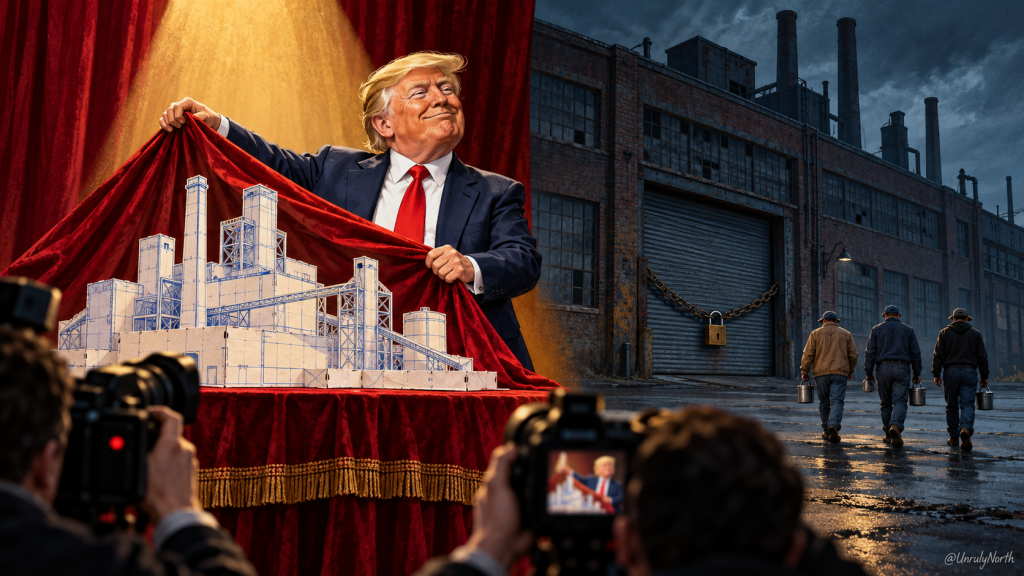
Donald Trump found room in the Oval Office for a factory that might employ 1,750 people in 2030. Days later, he found no room in his Ohio campaign speech for nearly 1,400 manufacturing workers who had just lost their jobs. The proposed investment received presidential celebration. The existing jobs disappeared without an acknowledgement from the president campaigning nearby. That contrast exposes how casually Trump treats the distinction between promising prosperity and delivering it. www.reuters.com
On September 28, Trump presented Mesabi Metallics’ proposed Iowa steel complex as evidence that his economic programme was working. The project carries an announced investment of US$15 billion and the prospect of substantial employment. But the company behind this supposedly triumphant demonstration of American industrial strength is controlled by India’s Essar Group. Its commitment to Iowa was also less settled than the White House performance suggested. Trump had secured the photographs and the political credit before the state had secured a completed deal. www.mesabimetallics.com
There is a serious industrial opportunity underneath the promotion. That makes the exaggeration more objectionable. Communities hoping for stable employment deserve a clear account of what has been agreed, what remains conditional and who carries the risk. Instead, Trump offered the familiar spectacle of a president treating an investment announcement as a personal accomplishment, with the difficult work of delivery left to other people.
The deal was still being assembled
The gap between the presentation and the paperwork was substantial. According to the Associated Press, Commerce Secretary Howard Lutnick declared that the “deal is done.” Yet, by October 2, Mesabi still needed to submit a full application to Iowa’s economic development authority, and local officials said it had not committed to the expected site. Iowa had just expanded its incentives legislation while competing with Arkansas and Kentucky. apnews.com
A company considering several locations is entitled to negotiate. A president celebrating one of those locations as a secured national victory owes the public more precision. The administration’s confidence ran ahead of the actual commitments. Trump was already collecting applause while state officials were still working to turn the announcement into something they could contractually rely upon.
That is how a prospective factory becomes an election asset before it becomes an employer. The investment figure is immediate, enormous and easy to repeat. The uncertainties are less photogenic: applications, agreements, financing, construction schedules and the conditions attached to public assistance. Each can determine whether the promised jobs materialise. None should become a footnote simply because the president has already taken his bow.
Mesabi’s own description of the steel project is more useful than the political theatre. It distinguishes between more than 6,000 anticipated construction jobs and approximately 1,750 permanent positions once the facility opens. Both would matter to the people hired. They represent different kinds of employment at different stages of a project, and neither figure establishes that the permanent manufacturing workforce already exists. mesabimetallics.com
The construction forecast should be taken seriously and examined as the work proceeds. It should also remain separate from permanent employment. Combining every projected benefit into one triumphant impression lets politicians spend the same promise several times: once when announcing it, again when financing is arranged, again at groundbreaking and again if production eventually begins. Workers receive their wages only when there is a job to perform.
“American” steel, Indian ownership
Mesabi is based in Minnesota, but its corporate backing comes from Essar, an Indian multinational conglomerate. The company’s proposed supply chain would connect American ore with American steelmaking. That would make its output domestically produced. It would not make the controlling industrial group American-owned. Those distinctions are easy enough to explain when a government is interested in informing people. www.wsj.com
Trump’s presentation invites a much simpler impression: America is rebuilding itself because he made it happen. The actual arrangement involves a foreign industrial group pursuing commercial opportunities, American communities competing to attract its investment and public institutions helping make the development possible. Foreign ownership can coexist with valuable domestic employment. It also means the company’s decisions will follow its commercial interests, which may differ from the political needs of the president promoting it.
The public contribution deserves particular attention. The Export-Import Bank announced on September 28 that its board had approved a US$770-million direct loan for Mesabi’s Minnesota iron-ore operation, which is intended to supply the Iowa mill. This is identifiable government financial backing for the proposed supply chain. The bank’s own announcement supplies a more concrete measure of public involvement than vague claims that presidential toughness alone is bringing industry home. exim.gov
A foreign-controlled company receiving American public support may deliver an excellent project. That outcome would need to be demonstrated. Taxpayers are entitled to know the terms, the protections and the milestones before political leaders treat their participation as an uncomplicated success. Patriotism is a poor substitute for due diligence, especially when an administration wants the credit immediately while the public waits years to learn whether its confidence was justified.
Minnesota has heard promises before
The history behind this announcement supplies ample reason to ask hard questions. Essar previously pursued an integrated mining and steelmaking development at Nashwauk, Minnesota. The project encountered repeated delays and entered bankruptcy in 2016. Subsequent ownership changes and attempts to restart construction prolonged the uncertainty. This was a substantial industrial ambition that repeatedly failed to arrive on the promised timetable. www.wsj.com
In an August 2018 letter to Iron Range residents, then-governor Mark Dayton described years of broken promises, missed deadlines and frustration. His conclusion was practical: renewed construction would provide the evidence that another assurance could not. Communities had already heard confident statements from successive owners. They needed something they could see and verify. www.leg.mn.gov
Mesabi’s Minnesota operation has since advanced substantially. The company reports major investment, ongoing construction and employment at the mine and pellet facility. That progress should be acknowledged. It also illustrates how long industrial development can take and why completion matters more than the ceremony announcing it. A functioning mine in Minnesota does not establish that a separate steel complex in Iowa has been secured or delivered. mesabimetallics.com
The relevant history is therefore more serious than a cheap prediction that the new project will fail. It establishes an obligation to scrutinise the promises. What financing is firmly committed to the Iowa mill? What obligations bind the developer to the state? What happens if costs rise, construction slips or employment falls below projections? Which public benefits depend on performance, and how will that performance be verified?
Those questions should have accompanied the presidential celebration. They remain central after the cameras have moved on. Trump’s eagerness to claim a victory does nothing to resolve them.
The workers missing from the speech
At the former Navistar facility in Springfield, the layoffs took effect on September 30, two days after the Iowa announcement. Trump campaigned in nearby Vandalia on October 3. AP reported that he highlighted investments elsewhere while leaving the layoffs unmentioned. The agency also reported Roshel’s plans to acquire the site and rebuild employment, meaning its industrial future remains open even as workers face an immediate interruption in their livelihoods. apnews.com
The shutdown was covered by journalists. The omission that can be established is the president’s. An inconvenient loss of established manufacturing employment had no place in the economic success story he chose to tell voters in the same region.
That choice deserves a scathing assessment. Trump cannot reasonably demand personal credit for a company’s projected hiring while treating actual layoffs as irrelevant to his performance. If manufacturing employment is a test of his economic leadership, the test includes workers leaving established plants. It includes the wages interrupted, the uncertainty imposed on households and the difficulty of replacing a skilled job close to home.
Nor can a proposed position in another state, years in the future, reimburse a family for income lost today. Treating the two as interchangeable reduces workers to convenient numbers in a campaign speech. Geography, skills, timing and household obligations determine whether an opportunity is useful to a particular person. A national announcement does not remove those constraints.
Trump’s approach reverses the proper order of accountability. He claims the reward when a promise is made, well before its conditions have been met. The people whose livelihoods depend on the outcome must wait through the financing, approvals and construction. When existing employment disappears, they also bear the immediate consequences, whether or not the president considers their experience worth mentioning.
The Iowa mill may eventually succeed. If it does, its workers, builders and surrounding communities will have something substantial to celebrate. Until then, voters are entitled to judge the administration by what exists alongside what has been proposed. That means keeping the unanswered questions in view and demanding an account of the jobs already lost.
Trump rushed to occupy the centre of a victory that had not yet been secured. He then campaigned near workers whose loss had already become real and left them out of the story. The public should refuse that selective accounting. A president who wants applause for future paycheques owes an answer to the people whose paycheques have just stopped.
Sources
- Mesabi Metallics: Proposed Iowa steel complex and employment projections
- Associated Press: Iowa incentives and outstanding project commitments
- Export-Import Bank: Approved financing for the Minnesota operation
- Minnesota governor’s 2018 account of the Nashwauk project’s difficulties
- Associated Press: Springfield layoffs and Trump’s Ohio rally