
Hands Off Brazil
Trump condemns foreign election interference while using American power to pressure Brazil and protect the Bolsonaro dynasty. As the presidential election heads to a runoff, tariffs, sanctions and political ties expose an administration that demands sovereignty for itself and submission from others.
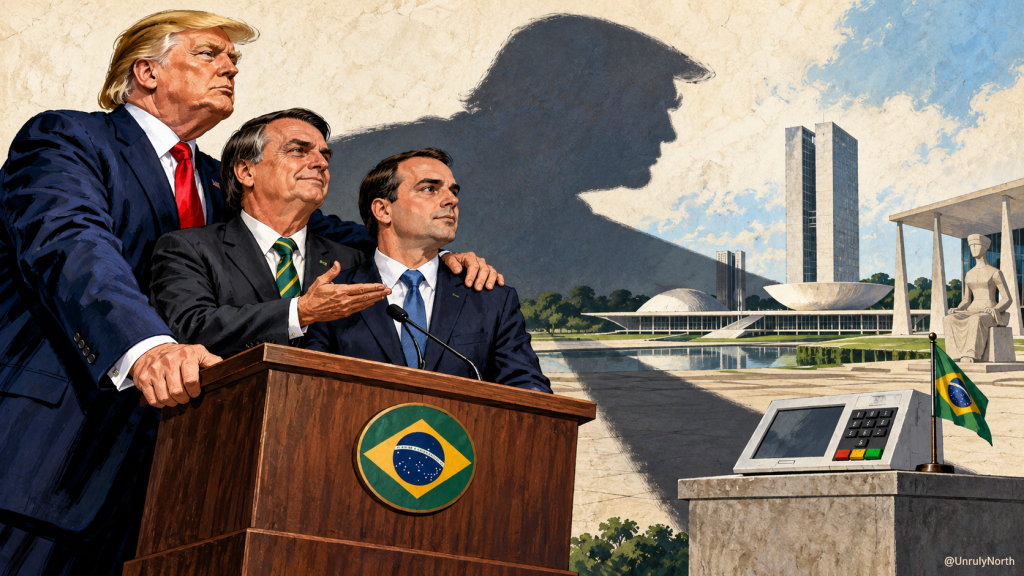
Donald Trump’s administration has used American economic and diplomatic power to defend the Bolsonaro family, punish Brazilian institutions and intervene in the political struggle now approaching its decisive vote. The president who treats alleged foreign interference in American elections as an intolerable violation has shown considerably less respect for the right of Brazilians to govern themselves.
On October 4, Senator Flávio Bolsonaro won 47.03 per cent of valid votes, ahead of President Luiz Inácio Lula da Silva’s 45.16 per cent, according to Brazil’s electoral court with virtually all ballots counted. They will contest a runoff on October 25. The result puts the son of a convicted coup plotter within reach of the presidency—and gives Washington’s campaign of pressure an immediate political context. Tribunal Superior Eleitoral
There is no basis for claiming Trump produced that result. Brazilian voters have their own grievances, convictions and reasons for rejecting Lula. But respecting their agency also means examining a foreign government’s efforts to influence the conditions under which they voted. The record includes economic punishment explicitly linked to Jair Bolsonaro’s prosecution, sanctions against a judge overseeing his case, lobbying by his son Eduardo, and disputed American initiatives concerning Brazil’s electoral institutions.
This is not a story about an American president expressing an opinion. It is about the conversion of personal political solidarity into state power—and the hypocrisy of calling that interference when someone else does it, but freedom when Washington does.
A tariff with a political demand attached
The clearest evidence does not come from Lula’s accusations. It comes from the White House.
Trump’s July 30, 2025, executive order targeting Brazil imposed an additional 40 per cent tariff on covered Brazilian products, bringing the headline rate on affected goods to 50 per cent. The order explicitly condemned Jair Bolsonaro’s prosecution and portrayed it as a threat to Brazil’s 2026 presidential election. It declared a national emergency over Brazilian conduct that supposedly threatened the United States. www.whitehouse.gov
The inversion was extraordinary. A Brazilian court was prosecuting a former Brazilian president over efforts to overturn a Brazilian election. Trump treated that proceeding as grounds for economic action by the United States. His administration was demanding that another country’s institutions accommodate his judgement about his political ally.
That is economic coercion, not an ordinary disagreement over market access. Tariffs are paid initially by American importers, but they can also suppress demand, squeeze exporters and threaten employment. Linking them to a criminal prosecution turns commercial relationships into pressure points: businesses and workers become collateral in a dispute over whether a powerful politician should answer to the law.
The administration’s subsequent trade measures require a distinction. On July 15, 2026, the U.S. Trade Representative announced a separate 25 per cent tariff on certain Brazilian goods under Section 301, following an investigation into digital trade, intellectual property, market access and other practices. Those were the stated grounds; the later measure cannot simply be presented as identical to the Bolsonaro-linked 2025 order. United States Trade Representative
Nevertheless, its political use was immediate. Rubio blamed Lula’s handling of negotiations, while Flávio blamed Lula for the tariff increase. Lula accused the Bolsonaro family of helping engineer the pressure for electoral advantage; the family denied it. Reuters also reported polling suggesting the tariffs had pushed many voters toward Lula. The intervention’s effectiveness was uncertain, but its intrusion into the campaign was unmistakable. www.reuters.com
A pressure campaign does not become acceptable because it backfires. Nor does an administration erase an explicitly political threat by later invoking conventional trade complaints.
Punishing the judge, protecting the friend
Economic pressure was accompanied by action against Justice Alexandre de Moraes, a central figure in the proceedings against Jair Bolsonaro.
In July 2025, the State Department revoked Moraes’s visa and those of immediate family members. Treasury then imposed Global Magnitsky sanctions. Treasury Secretary Scott Bessent’s announcement expressly included Bolsonaro’s prosecution among its complaints, alongside allegations of censorship and arbitrary detention. These were the administration’s accusations—not independent findings establishing that Bolsonaro’s prosecution was illegitimate. U.S. Department of the Treasury
The chronology matters: Washington removed Moraes, his wife and the associated Lex Institute from the sanctions list on December 12, 2025. Those sanctions should not be described as still operating today. Their removal, however, does not erase the earlier decision to deploy American financial power against a foreign judge while demanding relief for an American president’s ally. Office of Foreign Assets Control
Moraes is not beyond criticism. His expansive investigations and restrictions on online speech have generated concerns about judicial overreach, including within Brazil. Those questions deserve scrutiny on their merits. They do not establish that Jair Bolsonaro was innocent, or that Trump was entitled to determine which Brazilian proceedings could continue. reuters.com
The administration’s position was especially cynical because it claimed to oppose politicized justice while making a judge’s treatment of a political friend an international economic issue. Washington did not need to control the courtroom to exert pressure on it. The threat was that judicial decisions could carry consequences imposed by a superpower.
The family’s Washington operation
Eduardo Bolsonaro’s role makes the relationship more concrete than a vague affinity between right-wing leaders.
In June 2026, Brazil’s Supreme Court convicted him of coercion connected to efforts to obtain American intervention in his father’s prosecution. He received a sentence of four years and two months. Prosecutors’ case concerned lobbying for U.S. pressure against Brazilian authorities; his defence disputed the evidence. The court’s published record confirms the conviction and sentence. www.reuters.com
The political contradiction is difficult to miss. A movement that wraps itself in the national flag sought help from a foreign government against its own country’s institutions. The sovereignty it celebrated became expendable when the family’s legal interests were at stake.
These connections were built over years. Jair and Eduardo Bolsonaro visited Trump at Mar-a-Lago. Eduardo joined Steve Bannon’s international populist initiative, and Bannon amplified Bolsonaro’s claims about voting machines. After the January 2023 attack in Brasília, Bannon described the rioters as “Brazilian freedom fighters.” AP News
The relationship also had organizational foundations. Agência Pública documented how Gettr, then run by former Trump adviser Jason Miller, sponsored Brazilian conservative gatherings associated with Eduardo’s institute before the 2022 election, including Conservative Political Action Conference events. This was a network of conferences, media platforms and political relationships—not merely two presidents exchanging compliments. Such networking is not inherently unlawful, but it explains how the movements developed access and shared narratives. Agência Pública
By May 2026, Flávio was meeting Trump in the Oval Office, accompanied by Eduardo and ally Paulo Figueiredo. He subsequently reported meetings with Vice President JD Vance and Secretary of State Marco Rubio. The White House confirmed the Trump meeting. Lula had also met Trump earlier that month, so access alone cannot prove an interference operation. It is the combination of access with the documented pressure campaign that matters. www.investing.com
The authoritarian inheritance
Bolsonarism’s contempt for democratic restraints did not begin when Jair lost an election.
He openly celebrated Brazil’s military dictatorship and praised Carlos Alberto Brilhante Ustra, associated with its torture apparatus, as a “national hero.” His authoritarian sympathies were not obscure material uncovered after his presidency. They were part of the public record before Trump’s administration began presenting him as a persecuted defender of freedom. reuters.com
That history matters because the defence of Bolsonaro depends on stripping his prosecution of its substance. In Washington’s preferred account, a popular conservative was targeted by hostile judges. The actual proceedings concerned the destruction of constitutional government.
In June 2023, Brazil’s electoral court barred Jair Bolsonaro from standing for election for eight years over abuse of political power and misuse of the media. The case involved a meeting with foreign ambassadors at which he attacked the electoral system without evidence. That electoral ruling was separate from his later criminal conviction. Tribunal Superior Eleitoral
In September 2025, the Supreme Court sentenced him to 27 years and three months in the coup case. The court identified him as the leader of the criminal organization. Subsequent court records describe the proceedings as concerning an effort to prevent Lula’s inauguration and keep Bolsonaro in office. This was not a conviction for conservatism, criticism of Lula or an unpopular speech. noticias.stf.jus.br
The resemblance to Trump’s conduct is significant, but the legal outcomes must not be conflated. Trump was not convicted in the federal election-subversion case. Special counsel Jack Smith concluded that the evidence could have sustained a conviction, but the case ended before trial following Trump’s election victory and impending return to office. That was a prosecutor’s assessment, not a jury verdict. reuters.com
The shared political method nevertheless remains visible: challenge the legitimacy of defeat, turn institutional resistance into evidence of conspiracy, and portray accountability as persecution. The movements make the leader’s entitlement to power more important than the procedures that determine who may exercise it.
Trump has also demonstrated what restoration can mean. On returning to office in January 2025, he commuted specified January 6 sentences, pardoned others convicted of offences connected to the attack and directed the dismissal of pending cases. Presidential power became the means of undoing accountability for supporters involved in the assault on the transfer of power. The White House
That precedent gives the Bolsonaro family’s return a meaning beyond an ordinary change of government.
Election integrity as a political instrument
The struggle over Brazil’s institutions has continued into the present campaign.
In July, Brazil denied visas to State Department officials Riley Barnes and Samuel Samson. Brazilian officials told Reuters their proposed visit sought to discredit the electoral system; Washington said it was a routine discussion of election integrity and freedoms. Around the same period, Flávio falsely claimed Brazilian voting machines came from Smartmatic. The company and Brazil’s electoral court rejected that claim. Flávio denied questioning the system’s integrity. www.reuters.com
Requesting election observation is not inherently sinister. Credible observation can strengthen public confidence. But its value depends on evidence and impartiality. When unsupported claims circulate through an ideological network, the language of scrutiny can become a vehicle for preparing supporters to reject an unwelcome result.
There is also an unresolved funding question. Brazilian authorities have sought an investigation into a reported American award for groups opposing the Supreme Court under the banner of combating “lawfare” and censorship. The complaint arose from reporting about State Department human-rights funding. It does not establish that money reached Flávio’s campaign, or that alleged recipients committed crimes. Folha
On October 4, Federal Police director Andrei Rodrigues said a preliminary procedure was examining suspected foreign interference and financing, but a formal police inquiry had not yet been instituted in that matter. Electoral court president Kassio Nunes Marques had said the election faced no concrete international threat. Those distinctions must remain in the record. Folha
There is no demonstrated basis here for calling Sunday’s count fraudulent. Political pressure, suspected foreign funding and manipulation of vote totals are different things. Conflating them would reproduce the very tactic this article condemns.
But the absence of proven ballot manipulation does not absolve Washington of its documented conduct. A government can interfere with another country’s political choices without changing a single electronic vote. It can impose costs, intimidate institutions and help an allied movement present itself as the route out of a crisis the foreign government helped create.
A softer voice, the same family project
Flávio’s presentation as a more moderate Bolsonaro deserves scrutiny against his own record.
Folha de S.Paulo’s examination of his 2017 biography of his father found praise for the military dictatorship and Ustra, denial that the 1964 takeover constituted a coup, and attacks on the credibility of electronic voting. Those are Flávio’s positions in his own writing, not simply his father’s views being assigned to him by association. Folha
His candidacy also carries a direct family objective. Jair selected him as his successor, and Reuters identified freeing his father as a central goal. Flávio has expressed the wish to receive the presidential sash from Jair. His platform combines Christian traditionalism, market-oriented policies and hostility toward the left, while presenting him as a less combative version of the former president. www.reuters.com
A quieter manner does not resolve the underlying question: would a Bolsonaro presidency respect the institutions that held the family accountable, or seek to subordinate them? The danger is not that every conservative reform is authoritarian. It is that democratic election could supply the authority for a campaign of institutional revenge and family rehabilitation.
Brazilian voters are entitled to demand effective policing, economic improvement and an alternative to Lula. None of those demands requires accepting that the presidency should become a remedy for the Bolsonaro family’s legal problems.
Sovereignty for Washington, submission for everyone else
Trump’s own words provide the standard by which his administration should be judged.
His March 2025 election order argued that foreign financial involvement “undermines the franchise and the right of American citizens to govern their Republic.” The underlying principle is sound: citizens should determine their government without outsiders purchasing influence over their choices. Yet that principle is meaningless if it applies only north of the American border. The White House
The administration’s National Security Strategy exposes the contradiction. It professes respect for sovereign nations while promising to restore American predominance in the Western Hemisphere and to “reward and encourage” regional governments, parties and movements aligned with Washington. The document treats resistance to outside influence as an American entitlement while making the cultivation of compliant political forces an American objective. whitehouse.gov
This is the imperial assumption beneath the democracy rhetoric: the United States decides when another country’s sovereignty deserves respect and when its institutions are obstacles to be overcome. Courts become oppressive when they prosecute a friend. Economic punishment becomes a defence of liberty. Foreign influence becomes objectionable only when somebody else exercises it.
The October 25 election belongs to Brazilians, including those who oppose Lula. Its legitimacy does not depend on whether it produces the outcome Washington wants—or the outcome Trump’s critics prefer. That principle requires accepting the vote while rejecting attempts to make Brazil’s economic wellbeing or institutional independence contingent on American political approval.
Trump’s administration has helped a family that sought foreign pressure against its own country’s justice system, and defended a former president convicted of trying to overturn his people’s choice. It has done so while claiming the authority to lecture everyone else about electoral integrity.
Brazil does not owe that administration obedience, gratitude or a Bolsonaro restoration. A country’s freedom to choose its government includes the freedom to reject Washington’s friends without being punished for it.
Sources
- Brazil’s electoral court: first-round results and the presidential runoff.
- White House: July 2025 Brazil tariff order linking economic action to Bolsonaro’s prosecution.
- U.S. Treasury: December 2025 removal of the Moraes sanctions.
- Agência Pública: the Trump-linked political network supporting Bolsonarism.
- Reuters: the disputed American electoral mission and false voting-machine claims.
- Folha: the preliminary investigation into suspected foreign interference.