America.gov Knew Biden Won. Then It Stopped Answering.
Trump’s administration promised truthful government AI. America.gov then stopped answering factual questions about the president’s own record. Against its own standards of accuracy and transparency, the launch exposes a government demanding honesty from technology while failing to deliver it itself.
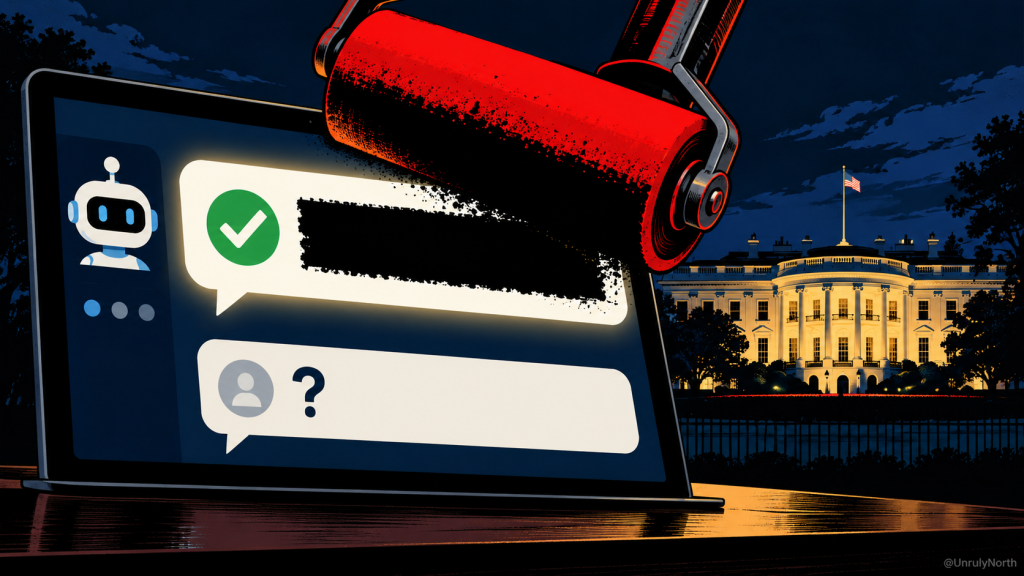
The Trump administration has given Americans a revealing demonstration of what its commitment to truthful artificial intelligence means in practice. On September 29, it launched America.gov with a promise of accurate answers drawn from government information. During the launch, the Associated Press recorded the site changing its response about the 2020 election from a factual answer to a refusal to discuss “political questions.” It also refused questions about Trump’s impeachments and felony convictions. AP News
A government information service that cannot consistently answer straightforward questions about the president’s public record has a serious credibility problem. The failure becomes more damning when that same administration has written rules demanding historical accuracy, truthfulness, and freedom from partisan manipulation in federal AI. Trump’s government is inviting Americans to trust a system whose launch immediately raised questions about whether uncomfortable facts will remain accessible through it.
The White House’s own announcement made the promise explicit: “Americans can ask any question on America.gov and get an up-to-date answer.” Its accompanying executive order requires the technology used by the service to be accurate, reliable, and transparent. Those are the administration’s standards. Applying them to its own conduct exposes a gulf between the service it advertised and the answers people received. The White House
There is nothing inherently partisan about identifying the winner of a certified election. The National Archives records Joe Biden’s 2020 victory, with 306 electoral votes to Trump’s 232. Citizens should not have to wonder whether an official gateway will provide that information depending on how politically inconvenient it is for the person occupying the White House. A public record does not become an opinion because a president dislikes it. www.archives.gov
That distinction matters because the administration is encouraging people to place a new intermediary between themselves and government information. An interface that delivers answers can also shape what users discover, which sources they encounter, and which questions appear legitimate. The responsibility attached to that power demands more than a launch ceremony and assurances of technological brilliance.
The administration’s own rules indict its performance
In July 2025, Trump signed an executive order titled “Preventing Woke AI in the Federal Government.” Its political framing singled out diversity, equity, and inclusion as a threat to reliable information. Its operative principles, however, make a broader commitment: models acquired by federal agencies should answer factual questions truthfully, prioritise historical accuracy and scientific inquiry, and acknowledge uncertainty when reliable information is incomplete. The order also calls for neutral, nonpartisan tools. The White House
Those principles are reasonable tests for a public information service. Their credibility depends on whether they apply when the facts are awkward for the administration imposing them. Historical accuracy cannot mean correcting distortions about the Founding Fathers while becoming evasive about a recent presidential election. Objectivity cannot depend on whether an answer supports the president’s preferred account of events.
The administration followed that order with an Office of Management and Budget memorandum in December 2025. It established requirements for agencies procuring large language models—the systems that generate conversational answers—and addressed the information agencies should obtain to assess compliance. Its guidance includes vendor documentation, acceptable-use policies, and mechanisms for reporting outputs that violate the stated principles. whitehouse.gov
Whether America.gov’s particular contracts and implementation comply with those requirements needs further examination. The procurement rules do not, by themselves, prove a contractual violation whenever a chatbot refuses a question. What they establish is that this administration knows how to articulate a standard of truthful, accountable AI. It has no excuse for treating the standard as a slogan when its own service is under scrutiny.
A factual question can concern politics without requesting political persuasion. Asking who won an election requests a result. Asking what the Constitution permits requests an explanation of the governing text. Asking whether a public official was impeached requests information about an institutional proceeding. A well-designed government service should distinguish those requests from demands to endorse a candidate or manufacture campaign arguments.
The Constitution provides another clear example. The 22nd Amendment bars anyone from being elected president more than twice. Explaining that restriction is basic civic information. Constitutional limits do not become unsuitable for public discussion because they interfere with a president’s ambitions, and the government has no business encouraging citizens to treat the legal framework as a politically sensitive mystery. www.archives.gov
The exact cause of America.gov’s launch behaviour remains unresolved. The available reporting does not identify who authorised a change, whether a new restriction was deployed, or whether differing outputs reflected another technical cause. It does not establish that Trump personally ordered the refusals. Those unanswered questions should drive scrutiny of the responsible officials. They do not erase the administration’s responsibility for the service it launched.
The explanation needs to come with evidence. If a broad restriction was applied, officials should disclose its scope and timing. If inconsistent model behaviour caused the problem, they should explain how they detected and corrected it. If questions about the president were handled differently from comparable questions about other public figures, that would demand a particularly serious accounting.
“Super Intelligence” by presidential decree
The same day brought a second demonstration of the administration’s approach to public information. Trump signed an order directing executive agencies to replace “Artificial Intelligence” and “AI” with “Super Intelligence” and “SI” in new official communications and other non-statutory documents, to the extent permitted by law. The order’s definition initially covers the technologies already encompassed by the statutory definition of artificial intelligence. It does not demonstrate that those technologies have acquired superior capabilities. The White House
The administration has therefore ordered a change in the language government uses to describe the technology. It has not ordered a breakthrough into existence.
That distinction is especially embarrassing because Trump’s own 2026 Economic Report of the President explains the terminology more carefully. On printed pages 98–99, it distinguishes specialised AI from hypothetical artificial general intelligence and describes superintelligence as intelligence exceeding that of humans. It also acknowledges disagreement about the boundaries between these concepts. whitehouse.gov
The September order collapses those distinctions for official use. Its legal definition makes the relabelling possible, but it does not supply evidence of a corresponding technical advance. Americans deserve language that helps them understand a system’s abilities and limitations. Calling the technology “Super Intelligence” encourages an impression of extraordinary competence at precisely the moment a new government service should be earning confidence through demonstrated performance.
The order does not require previously issued historical documents to be rewritten. Its immediate effect concerns terminology in future executive-branch communications, while it also directs preparation of proposed legislative language. That scope makes the criticism concrete: the administration has made its preferred branding a government-wide instruction. The White House
There is a common concern running through the two developments. Public information becomes harder to assess when officials make the terminology more grandiose while the service’s response boundaries remain unexplained. Citizens need to know what the technology can do, where it can fail, and why it declines a question. Presidential enthusiasm supplies none of those answers.
Public information requires public accountability
America.gov’s ambitions make the launch failure consequential. The General Services Administration says the platform combines information from more than 29,000 government websites. GSA also identifies its Technology Transformation Services unit as the site’s organisational home, under Sam Corcos, working with the White House’s National Design Studio. There are identifiable institutions responsible for its operation. They should be held accountable for the answers it provides and the restrictions it applies. GSA
The executive order preserves agency control of records and existing ways to obtain services, including agency websites, telephone, mail, and in-person access. That provision matters. America.gov does not legally become the sole route to government information simply because the White House markets it as a unified gateway. Nevertheless, a service designed to simplify access will influence how people find information, particularly those who rely on the first answer they receive. The White House
An unexplained refusal can mislead without stating a falsehood. It can suggest that a settled fact is disputed, that a public record is inappropriate to consult, or that the answer lies outside legitimate civic inquiry. A government should be particularly careful about creating those impressions around the conduct of its own leaders.
The appropriate response is disclosure. GSA and the National Design Studio should explain the launch behaviour, publish understandable rules for restricted questions, and identify who approves changes affecting factual answers. They should provide enough documentation for independent reviewers to assess consistency across presidents, parties, and subjects. Users should also have a clear way to challenge inaccurate answers and unjustified refusals.
These demands follow directly from the service’s advertised purpose and the administration’s commitment to transparency. They do not require exposing private records or sensitive security information. They require officials to explain how a public-facing government product handles public facts.
The lasting issue is the administration’s willingness to accept scrutiny under standards it sets for others. It cannot credibly demand truth-seeking from AI vendors while leaving citizens to guess why its own gateway has become evasive. It cannot build justified trust by ordering a more impressive name for the technology. Trust comes from accurate answers, visible corrections, consistent rules, and officials who take responsibility when those rules fail.
Trump’s administration has chosen to promote itself as the authority on unbiased government AI. America.gov’s launch now puts that claim to a practical test. The people running the service owe Americans an account of what happened and a system that can describe the president’s record without treating embarrassment as a reason for silence. Until they deliver that, the White House’s promises of truth and transparency remain claims its own product has given the public reason to doubt.
Sources
- Associated Press: America.gov’s launch answers and subsequent refusals.
- White House: America.gov executive order and launch fact sheet.
- White House: Federal AI truth-seeking and neutrality order and implementing OMB memorandum.
- White House: “Super Intelligence” terminology order and 2026 Economic Report, printed pages 98–99.
- GSA: America.gov’s operation and organisational responsibility.
- National Archives: 2020 Electoral College results and the 22nd Amendment.